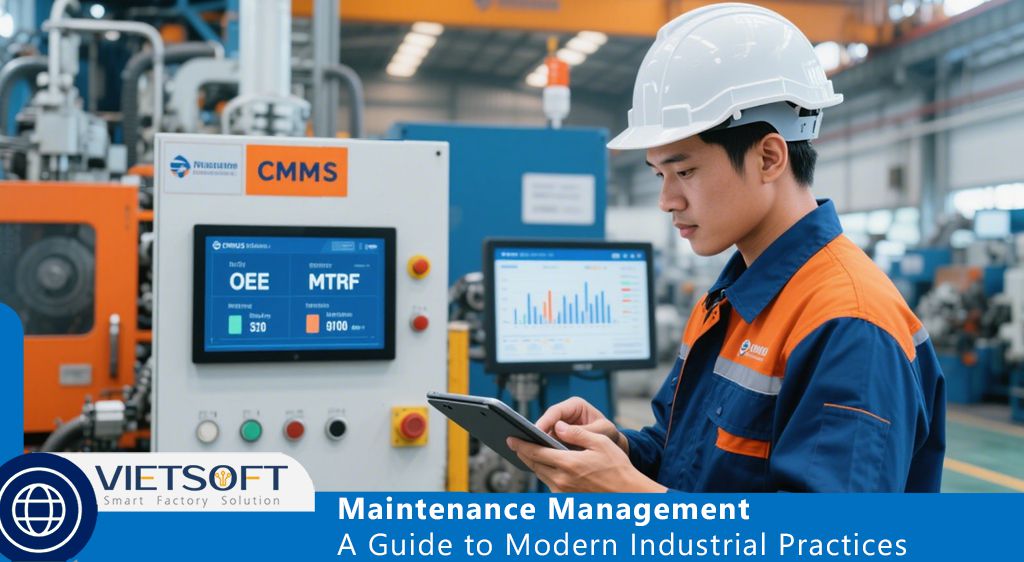
I. What is Maintenance Management?
Maintenance management refers to the systematic process of planning, organizing, and overseeing the upkeep of physical assets, such as machinery, equipment, and infrastructure, to ensure their optimal performance and longevity. It encompasses a range of activities, including scheduling regular inspections, performing preventive maintenance, and addressing repairs to prevent unexpected failures. The primary goal is to maintain operational efficiency, reduce downtime, and enhance workplace safety while minimizing costs.
Think of maintenance management as the backbone of a well-functioning industrial operation. Just as a firefighter prevents fires through proactive measures rather than just extinguishing them, maintenance management prioritizes prevention over reactive fixes. By addressing potential issues before they escalate, businesses can avoid costly disruptions and maintain smooth operations.
Key Objectives of Maintenance Management
Optimize Equipment Performance: Ensure assets operate at peak efficiency to support production goals.
Minimize Downtime: Reduce unplanned outages that disrupt operations and affect profitability.
Extend Asset Lifespan: Prolong the usability of machinery through regular maintenance.
Enhance Safety: Maintain equipment in safe working conditions to protect employees.
Reduce Costs: Lower repair expenses and avoid costly emergency interventions.
II. The Importance of Maintenance Management in Modern Industries
In today’s competitive industrial landscape, effective maintenance management is more critical than ever. Research from the U.S. indicates that for every dollar invested in proper maintenance, businesses can save at least $5 annually in operational costs. This return on investment highlights the strategic value of maintenance management in achieving long-term business success.
Why Maintenance Management Matters
Reduces Production Interruptions: Downtime due to equipment failure can halt production, delay deliveries, and damage customer trust. A well-executed maintenance plan minimizes these risks.
Lowers Operational Costs: Proactive maintenance prevents expensive emergency repairs and reduces energy waste caused by inefficient equipment.
Improves Safety Standards: Regular maintenance ensures that machinery operates safely, reducing the risk of workplace accidents.
Enhances Customer Satisfaction: Consistent equipment performance leads to high-quality products, fostering customer loyalty and strengthening brand reputation.
Supports Sustainability: Efficient maintenance reduces resource waste, aligning with environmentally conscious practices.
III. Common Challenges in Maintenance Management
Despite its importance, many businesses face significant challenges in implementing effective maintenance management practices. These issues often stem from outdated methods, lack of resources, or insufficient tools.
Key Challenges
Frequent Equipment Failures: Unexpected breakdowns disrupt production and increase repair costs.
Inefficient Record-Keeping: Manual methods like Excel or paper logs make it difficult to track equipment history or maintenance schedules.
Lack of Specialized Tools: Without advanced systems, monitoring performance metrics like OEE (Overall Equipment Effectiveness), MTBF (Mean Time Between Failures), and MTTR (Mean Time To Repair) is challenging.
Poor KPI Evaluation: Managers struggle to assess maintenance performance without clear data or analytics.
High Material Waste: Inefficient maintenance leads to increased scrap rates and energy consumption.
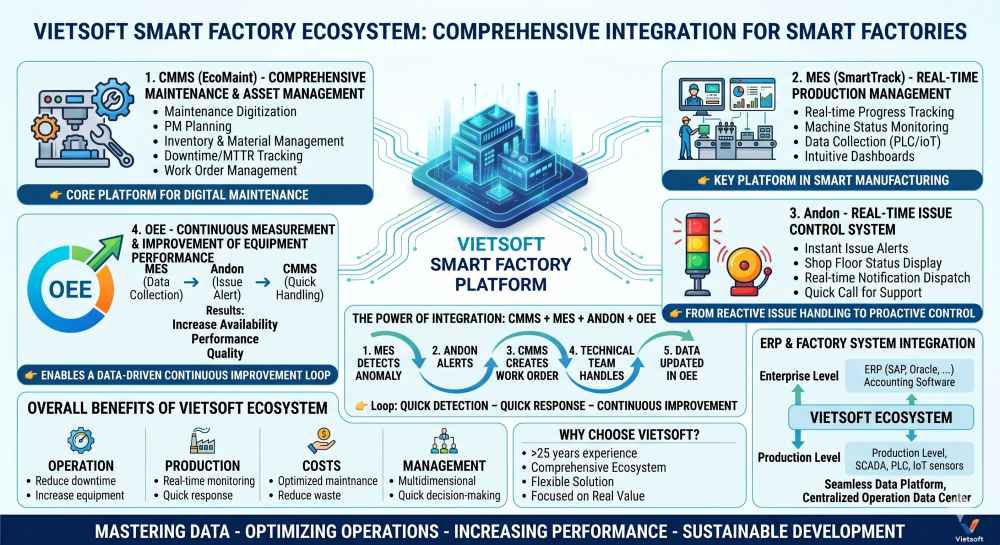
To address these challenges, modern enterprises are turning to advanced technologies such as AI, IIoT (Industrial Internet of Things), and CMMS (Computerized Maintenance Management Systems) like EcoMaint to streamline operations and enhance efficiency.
IV. Benefits of Effective Maintenance Management
Implementing a robust maintenance management strategy delivers measurable benefits that directly impact a company’s bottom line and operational success.
Key Benefits
Extended Equipment Lifespan: Regular maintenance, such as cleaning and part replacements, prevents wear and tear, extending the life of assets.
Reduced Downtime: Preventive maintenance can reduce equipment failures by up to 90%, ensuring continuous production.
Enhanced Workplace Safety: Well-maintained equipment minimizes hazards, protecting workers and reducing accident-related costs.
Cost Savings: According to ITIC, a single hour of downtime can cost businesses over $100,000. Proactive maintenance mitigates these losses.
Improved Product Quality: Consistent equipment performance ensures high-quality outputs, enhancing customer satisfaction.
V. Types of Maintenance Management Strategies
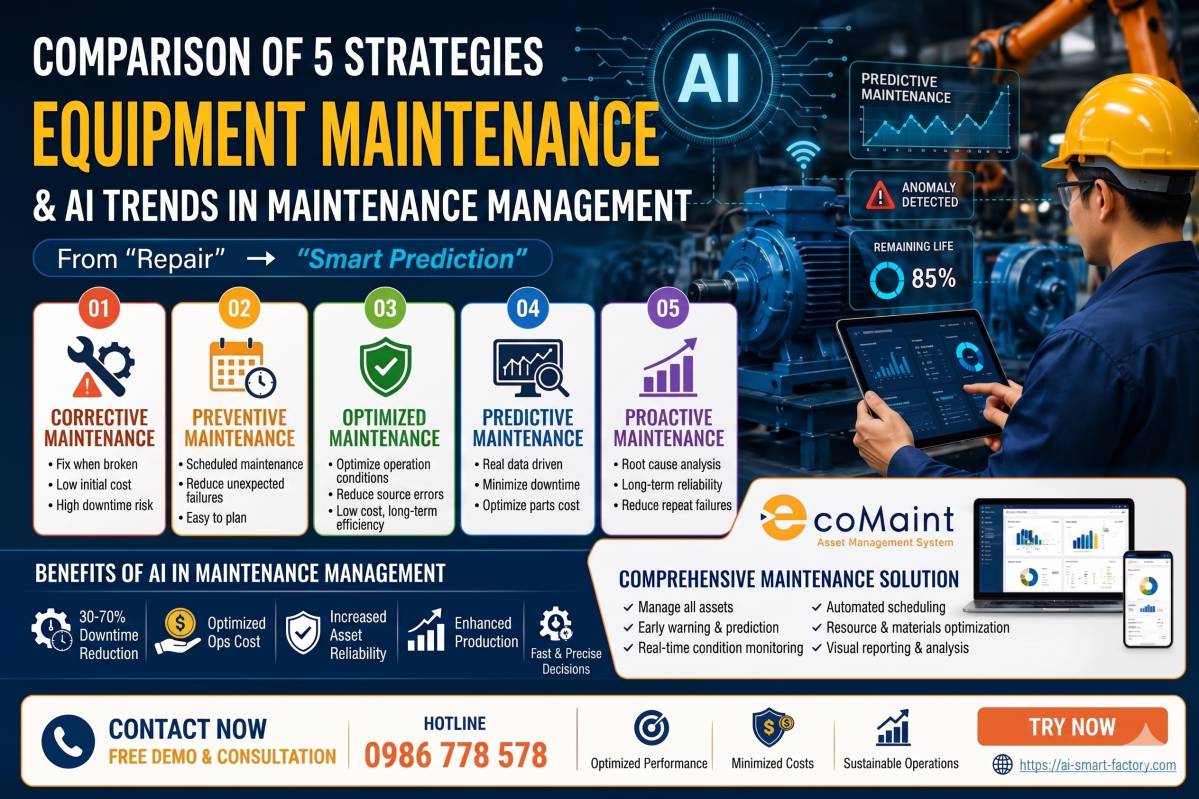
Modern maintenance management encompasses several strategies, each suited to different operational needs and asset types. Below, we explore the four most common approaches, along with their advantages and drawbacks.
1. Corrective Maintenance (Reactive Maintenance)
Corrective maintenance involves repairing equipment only after it fails. This approach is often used for low-priority assets with minimal impact on operations.
Advantages
Maximizes equipment usage by running assets until failure.
Requires minimal initial investment in planning or monitoring.
Disadvantages
Unpredictable downtime disrupts production schedules.
High repair costs due to emergency fixes or full replacements.
Risk of cascading failures affecting other systems.
2. Preventive Maintenance
Preventive maintenance involves scheduled inspections and repairs based on manufacturer recommendations or usage patterns to prevent failures.
Advantages
Extends equipment lifespan by addressing issues proactively.
Reduces unplanned downtime and repair costs.
Enhances workplace safety by maintaining optimal equipment conditions.
Disadvantages
May involve replacing functional parts, increasing costs.
Risk of failures occurring before scheduled maintenance.
Example: Scheduling an oil change for a utility vehicle every 500 hours of operation to prevent engine damage.
3. Predictive Maintenance
Predictive maintenance uses real-time data and analytics, often from IoT devices, to monitor equipment conditions and predict failures before they occur.
Advantages
Minimizes unnecessary maintenance by focusing on actual equipment conditions.
Reduces downtime through early detection of issues.
Optimizes resource allocation and inventory management.
Disadvantages
Requires significant initial investment in technology and training.
Demands skilled personnel to interpret data accurately.
Example: Using vibration analysis to detect early signs of bearing wear in a motor and scheduling maintenance before failure.
4. Lean Maintenance
Lean maintenance focuses on minimizing waste and optimizing resources through proactive planning and methodologies like 5S, Kaizen, and TPM (Total Productive Maintenance).
Advantages
Reduces unnecessary maintenance tasks, lowering costs.
Improves product quality and consistency.
Enhances equipment reliability and longevity.
Disadvantages
Requires significant time to overhaul existing processes.
Demands highly skilled technicians for effective implementation.
Example: Implementing 5S to organize maintenance tools and streamline workflows, reducing downtime during repairs.
VI. Planned vs. Scheduled Maintenance: Understanding the Difference
While often used interchangeably, planned and scheduled maintenance have distinct roles in maintenance management.
Aspect | Planned Maintenance | Scheduled Maintenance |
|---|---|---|
Definition | A comprehensive strategy outlining maintenance tasks and resource requirements. | A detailed timeline assigning specific tasks to technicians with deadlines. |
Application | Used to identify potential risks and plan corrective actions. | Executed after a maintenance plan is established, assigning tasks and timelines. |
Resources Needed | Risk assessments, tool lists, replacement parts, and procedural guidelines. | Software for task assignment, detailed schedules, and technician assignments. |
Use Case | A maintenance manager identifies tasks and resources, then passes them to scheduling. | A scheduler assigns tasks to technicians based on the maintenance plan. |
Example: For a conveyor belt showing signs of wear, planned maintenance involves identifying the issue and required parts, while scheduled maintenance assigns a technician to replace the belt on a specific date.
VII. The Maintenance Management Process
A structured maintenance management process ensures consistency and efficiency. Below is a step-by-step guide tailored for industrial operations:
Step 1: Inventory All Equipment
Create a detailed list of all machinery and equipment, categorized by location, type, or function. This helps managers track assets and prioritize maintenance tasks.
Step 2: Review Equipment History
Analyze past maintenance records, including breakdowns, repair times, and causes. This data informs future maintenance schedules and resource planning.
Step 3: Develop a Maintenance Plan
Based on equipment history and manufacturer guidelines, create a maintenance plan specifying inspection intervals, part replacements, and required resources.
Step 4: Schedule Maintenance Tasks
Assign tasks to technicians with clear timelines and resource allocations, ensuring minimal disruption to production.
Step 5: Execute Maintenance
Technicians perform scheduled maintenance or repairs according to the plan, adhering to safety and manufacturer standards.
Step 6: Verify and Document
After maintenance, conduct inspections to verify completion and update equipment records with details of repairs, parts used, and performance outcomes.
Key Considerations
Warranty Periods: Check warranty terms to leverage manufacturer support for repairs.
Comprehensive Services: Partner with vendors offering end-to-end maintenance solutions for efficiency.
Timely Execution: Adhere to schedules to avoid production delays.
Trusted Partners: Work with experienced maintenance providers to ensure quality.
VIII. Key Performance Indicators (KPIs) for Maintenance Management
Tracking KPIs is essential for evaluating the effectiveness of maintenance management. Below are three critical metrics:
1. Mean Time Between Failures (MTBF)
MTBF measures the average time a piece of equipment operates between failures, indicating reliability.
Formula:
MTBF = Total operational time ÷ Number of failures
Example: If a machine operates for 1,000 hours and experiences 5 failures, MTBF = 1,000 ÷ 5 = 200 hours.
2. Mean Time To Repair (MTTR)
MTTR measures the average time required to diagnose, repair, and restore equipment after a failure.
Formula:
MTTR = Total downtime ÷ Number of repairs
Example: If a machine is down for 10 hours across 4 repairs, MTTR = 10 ÷ 4 = 2.5 hours.
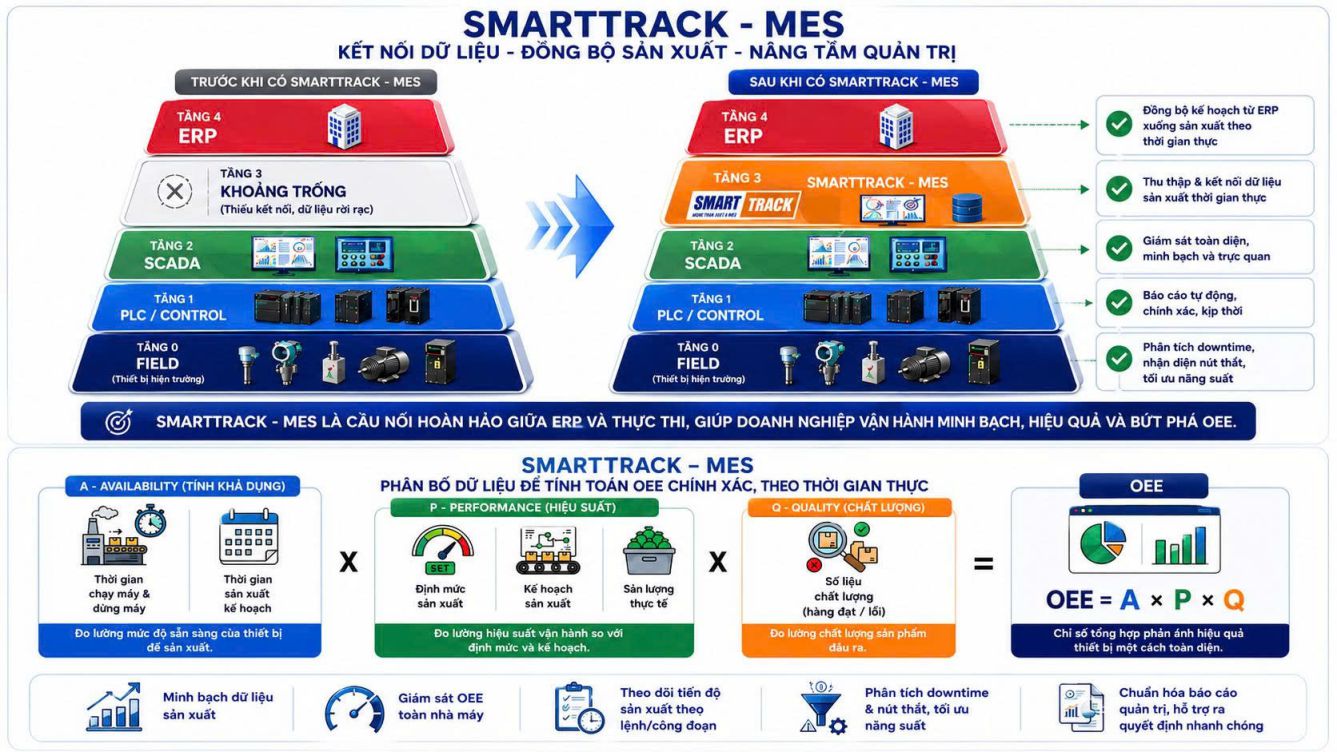
3. Overall Equipment Effectiveness (OEE)
OEE evaluates equipment performance by combining availability, performance, and quality.
Formula:
OEE = Availability × Performance × Quality
Availability: (Operating time ÷ Planned production time) × 100
Performance: (Actual output ÷ Maximum possible output) × 100
Quality: (Good units ÷ Total units produced) × 100
Example: If a machine has 90% availability, 85% performance, and 95% quality, OEE = 0.90 × 0.85 × 0.95 = 72.68%.
IX. Total Productive Maintenance (TPM): A Holistic Approach
TPM integrates preventive maintenance with total quality management, fostering a culture of shared responsibility across the organization. It aims to achieve:
Zero breakdowns
Zero defects
Zero waste
High employee morale
Pillars of TPM
Autonomous Maintenance: Operators perform basic maintenance tasks.
Focused Improvement: Continuous process optimization.
Planned Maintenance: Scheduled upkeep to prevent failures.
Quality Maintenance: Ensuring defect-free production.
Training and Education: Upskilling employees for better maintenance practices.
Initial Control: Preventing issues during equipment design or installation.
Office TPM: Streamlining administrative processes.
Safety, Health, and Environment: Prioritizing worker safety and sustainability.
Foundation: The 5S methodology (Sort, Set in order, Shine, Standardize, Sustain) underpins TPM by organizing workplaces for efficiency.
XI. Leveraging CMMS EcoMaint for Modern Maintenance Management
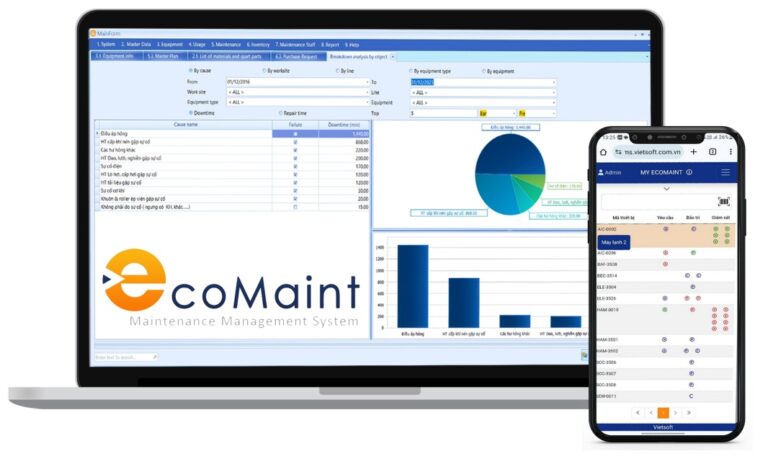
To overcome the limitations of manual maintenance tracking, businesses are adopting advanced CMMS solutions like EcoMaint. This software streamlines maintenance operations by providing a centralized platform for asset management, scheduling, and reporting.
1. Key Features of CMMS EcoMaint
Asset Management: Stores detailed equipment profiles, including serial numbers, purchase details, and maintenance history.
Maintenance Scheduling: Automates preventive maintenance plans and sends alerts for upcoming tasks.
Real-Time Monitoring: Tracks equipment performance and operational efficiency.
Comprehensive Reporting: Generates reports on maintenance activities, part replacements, and KPIs like OEE, MTBF, and MTTR.
Inventory Management: Manages spare parts to ensure availability and reduce costs.
2. Benefits of CMMS EcoMaint
Data-driven decision-making for optimized maintenance strategies.
Extended equipment lifespan through proactive care.
Reduced downtime with timely maintenance alerts.
Standardized processes for consistency and compliance.
Improved team productivity through automated workflows.
To explore how CMMS EcoMaint can transform your maintenance operations, request a demo today and discover a smarter way to manage your assets.
XII. The Role of a Maintenance Manager
A maintenance manager oversees all maintenance activities, ensuring equipment reliability and operational efficiency. Their responsibilities include:
Coordinating maintenance schedules and technician assignments.
Ensuring compliance with safety and regulatory standards.
Managing budgets and optimizing resource allocation.
Implementing new technologies to improve maintenance processes.
Educational Requirements
Minimum: High school diploma with relevant certifications (e.g., Certified Building Maintenance Technician).
Preferred: Bachelor’s degree in engineering, industrial management, or a related field.
Specialized Certifications: May be required depending on industry or region.
Salary Expectations
Maintenance managers earn an average of $81,000 annually, with experienced professionals potentially earning up to $130,000, depending on the industry and company size.
XIII. Conclusion
Maintenance management is a cornerstone of industrial success, enabling businesses to maximize equipment performance, reduce costs, and enhance safety. By adopting modern strategies like preventive, predictive, and lean maintenance, and leveraging advanced tools like CMMS EcoMaint, enterprises can achieve operational excellence. Whether you’re managing a small facility or a large manufacturing plant, a well-structured maintenance management program is essential for staying competitive in 2025 and beyond.
For a deeper dive into how CMMS EcoMaint can streamline your maintenance processes, visit our product page and start optimizing your operations today.