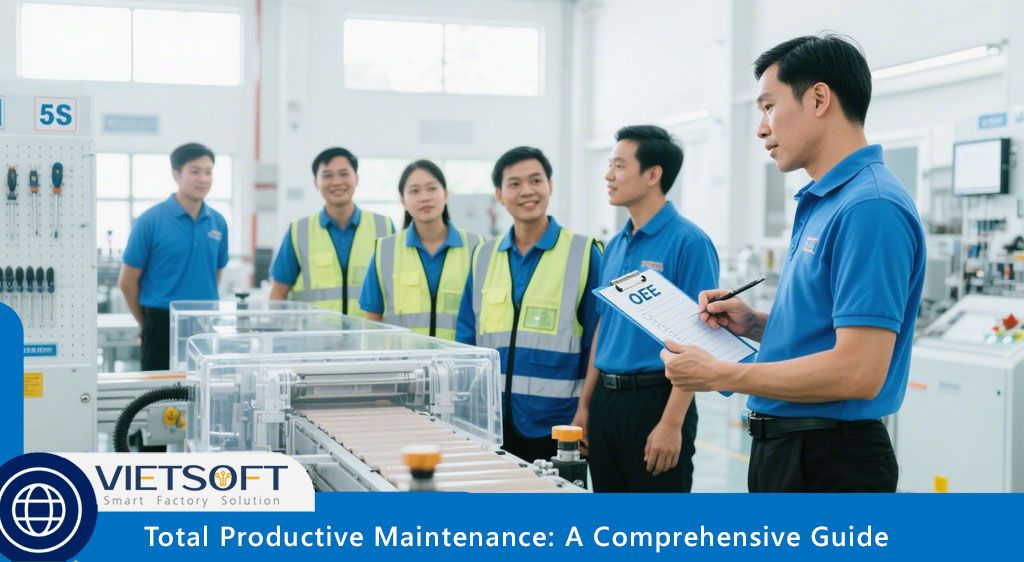
Total Productive Maintenance (TPM) is a transformative maintenance philosophy that engages every employee in an organization to maximize equipment effectiveness, minimize downtime, and enhance workplace safety. Originating in Japan, TPM has become a cornerstone of lean manufacturing, enabling organizations to achieve near-perfect production by reducing waste, defects, and accidents. This guide explores the history of TPM, its eight pillars, implementation strategies, and how modern tools like CMMS EcoMaint by Vietsoft can amplify its benefits.
I. History of Total Productive Maintenance
Total Productive Maintenance (TPM) was developed in Japan in the late 1950s by Seiichi Nakajima, often referred to as the “Father of TPM.” It emerged as an evolution of preventive maintenance practices at Nippon Denso (now Denso), a supplier for Toyota, which sought to enhance equipment reliability to support the lean manufacturing principles of the Toyota Production System. Introduced in the early 1970s by the Japan Institute of Plant Maintenance (JIPM), TPM built on the concept of involving all employees in maintenance, moving beyond the traditional reliance on specialized maintenance teams.
The philosophy gained traction in the 1960s as Japanese manufacturers faced increasing global competition and needed to optimize production efficiency. TPM’s focus on proactive maintenance and employee empowerment aligned perfectly with the lean movement’s emphasis on waste elimination. By the 1980s, TPM had gained international recognition, with companies like Toyota achieving significant improvements in productivity and quality, earning JIPM awards for excellence.
In the 1990s, TPM spread globally, particularly in North America and Europe, as industries recognized its potential to reduce downtime and costs. The integration of TPM with digital tools, such as Computerized Maintenance Management Systems (CMMS), further enhanced its effectiveness in the 2000s. Today, TPM remains a vital strategy in the era of Industry 4.0, leveraging IoT, predictive analytics, and automation to drive continuous improvement in manufacturing.
II. What is Total Productive Maintenance?
Total Productive Maintenance (TPM) is a holistic strategy that integrates maintenance into the daily operations of a facility, involving everyone from operators to top management. Unlike traditional maintenance, which relies heavily on specialized technicians, TPM empowers all employees to take responsibility for equipment care. The goal is to achieve “perfect production” by eliminating:
- Equipment breakdowns
- Small stops or slow running
- Product defects
- Workplace accidents
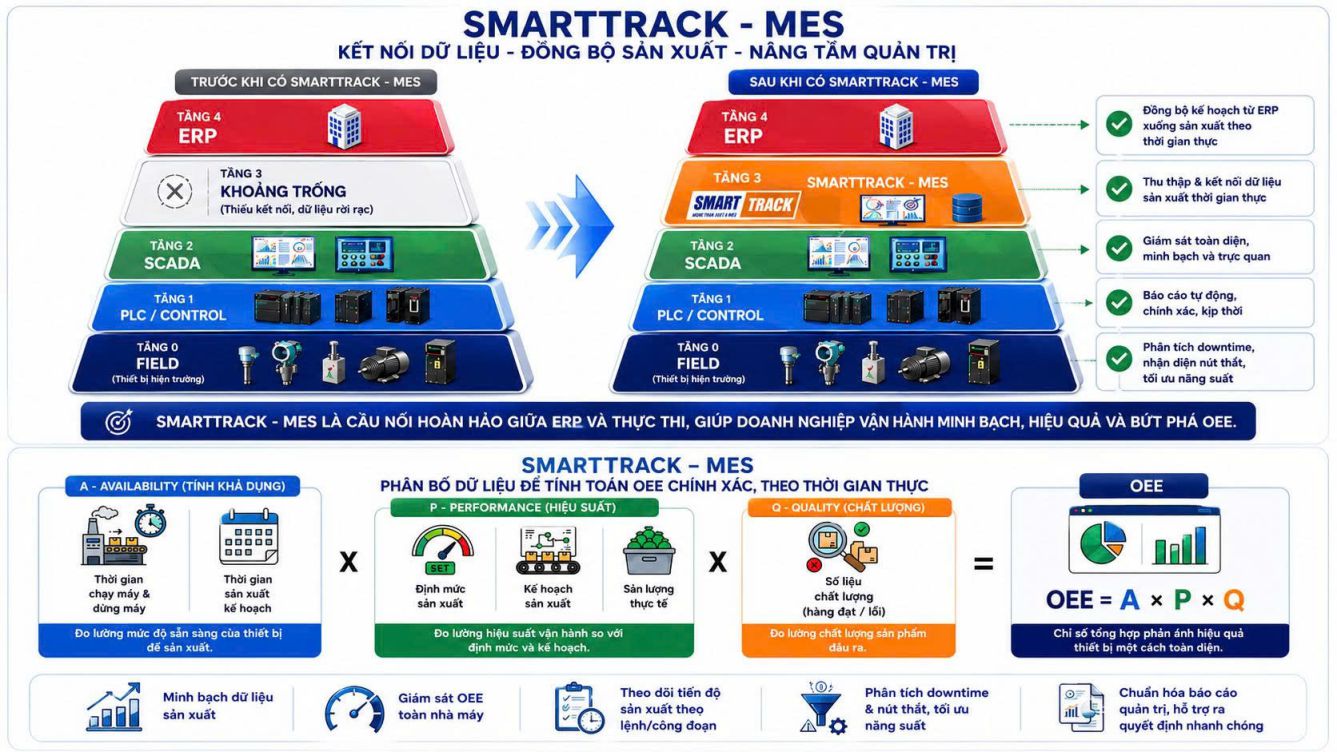
By fostering a culture of proactive maintenance, TPM enhances Overall Equipment Effectiveness (OEE), a key metric measuring availability, performance, and quality. This approach not only boosts productivity but also reduces costs, improves safety, and strengthens organizational cohesion.
III. Why Adopt Total Productive Maintenance?
In today’s competitive manufacturing landscape, equipment reliability is critical to maintaining production flow and meeting customer demands. Total Productive Maintenance offers a structured framework to achieve this by:
- Reducing Downtime: Proactive maintenance minimizes unplanned stoppages, ensuring continuous production.
- Improving Quality: By addressing defects early, TPM reduces rework and waste.
- Enhancing Safety: A clean, organized workplace, supported by the 5S methodology, mitigates risks.
- Lowering Costs: Higher OEE reduces maintenance and production costs.
- Empowering Employees: Involving operators in maintenance fosters a sense of ownership and accountability.
However, implementing TPM requires careful planning to avoid disruptions and ensure employee buy-in. With the right approach, TPM can transform maintenance into a strategic advantage.
IV. The 5S Foundation: The Bedrock of Total Productive Maintenance
The 5S methodology forms the foundation of Total Productive Maintenance, creating a disciplined, organized workplace that supports efficient maintenance. The five steps are:
1. Sort: Remove unnecessary items from the workspace, keeping only what is essential for daily operations.
2. Set in Order: Arrange tools and equipment logically, ensuring easy access and reducing wasted motion.
3. Shine: Maintain a clean work environment to facilitate inspections and identify issues like leaks or wear.
4. Standardize: Establish consistent procedures for the first three steps to ensure repeatability.
5. Sustain: Embed these practices into the organizational culture through regular audits and training.
This foundation ensures that equipment is maintained in a clean, organized environment, making it easier to detect and address issues early.
V. The Eight Pillars of Total Productive Maintenance
The eight pillars of TPM build on the 5S foundation, each focusing on a specific aspect of maintenance and operational efficiency. Below, we explore each pillar in detail, highlighting its role and practical applications.
1. Autonomous Maintenance: Empowering Operators
What It Is: Autonomous Maintenance shifts routine maintenance tasks, such as cleaning, lubrication, and inspections, to equipment operators. This empowers them to take ownership of their machines, freeing maintenance technicians for more complex tasks.
How It Works:
- Operators are trained to perform basic maintenance, such as checking for wear, cleaning components, and lubricating moving parts.
- Visual aids, like checklists and labeled set points, guide operators in maintaining equipment to a baseline standard.
- Regular audits ensure adherence to procedures and identify opportunities for improvement.
Benefits:
- Increases operators’ understanding of equipment, enabling early detection of issues.
- Reduces downtime by addressing minor problems before they escalate.
- Enhances operator engagement and accountability.
2. Focused Improvement (Kaizen): Driving Continuous Progress
What It Is: Focused Improvement, or Kaizen, involves small, cross-functional teams working together to identify and resolve recurring issues, aiming for incremental improvements in equipment performance.
How It Works:
- Teams analyze OEE data to pinpoint inefficiencies, such as frequent stoppages or defects.
- Root cause analysis tools, like fishbone diagrams, help identify underlying issues.
- Solutions are implemented during planned downtime, with effectiveness monitored over time.
Benefits:
- Targets high-impact problems, improving productivity and quality.
- Encourages collaboration across departments, fostering innovation.
- Standardizes successful improvements for long-term gains.
3. Planned Maintenance: Proactive Scheduling
What It Is: Planned Maintenance schedules maintenance tasks based on historical data, failure rates, and predictive analytics, minimizing disruptions to production.
How It Works:
- Maintenance schedules are created using data from CMMS systems, such as failure logs and wear patterns.
- Tasks are timed during low-production periods to avoid interrupting operations.
- Feedback loops, like component logs, help optimize maintenance intervals.
Benefits:
- Reduces unplanned downtime by addressing issues before they cause failures.
- Optimizes inventory management by predicting part replacement needs.
- Extends equipment lifespan through regular care.
4. Quality Maintenance: Ensuring Zero Defects
What It Is: Quality Maintenance integrates error detection and prevention into production processes, aiming to eliminate defects and ensure consistent product quality.
How It Works:
- Root cause analysis (e.g., 5 Whys) identifies sources of defects.
- Preventive measures, such as enhanced inspections or process adjustments, are implemented.
- Real-time monitoring tools track quality metrics to catch issues early.
Benefits:
- Reduces rework and scrap, lowering production costs.
- Improves customer satisfaction by delivering high-quality products.
- Minimizes downtime caused by quality-related issues.
5. Early Equipment Management: Designing for Reliability
What It Is: Early Equipment Management leverages insights from operators and maintenance teams to improve the design and installation of new equipment, ensuring maintainability and reliability.
How It Works:
- Feedback from TPM activities informs equipment design, focusing on accessibility and ease of maintenance.
- Collaboration with suppliers ensures new machines meet operational needs.
- Pilot testing validates design improvements before full deployment.
Benefits:
- Reduces startup issues and maintenance challenges.
- Enhances equipment performance from day one.
- Lowers long-term maintenance costs.
6. Training and Education: Building Competence
What It Is: Training and Education equips operators, technicians, and managers with the skills needed to execute TPM effectively, ensuring alignment across the organization.
How It Works:
- Operators receive training on routine maintenance and issue detection.
- Technicians learn advanced preventive and predictive maintenance techniques.
- Managers are educated on TPM principles and change management.
Benefits:
- Bridges knowledge gaps, improving maintenance quality.
- Fosters a culture of continuous learning and improvement.
- Enhances collaboration between departments.
7. Safety, Health, and Environment: Prioritizing Well-Being
What It Is: This pillar focuses on creating a safe, healthy, and environmentally friendly workplace, integrating safety into all TPM activities.
How It Works:
- Safety audits identify and mitigate risks, such as unguarded machinery or hazardous spills.
- Environmental considerations, like proper waste disposal, are standardized.
- Employee training emphasizes safe maintenance practices.
Benefits:
- Reduces workplace accidents, improving employee morale.
- Ensures compliance with safety and environmental regulations.
- Enhances productivity by minimizing safety-related disruptions.
8. TPM in Administration: Streamlining Support Functions
What It Is: TPM in Administration extends maintenance principles to administrative processes, such as procurement and scheduling, to support production efficiency.
How It Works:
- Administrative tasks are analyzed for waste, such as delays in ordering parts.
- Standardized procedures improve order processing and inventory management.
- Digital tools, like CMMS, streamline administrative workflows.
Benefits:
- Reduces delays in material availability, minimizing production interruptions.
- Enhances coordination between production and support functions.
- Improves overall operational efficiency.
VI. Implementing Total Productive Maintenance: A Step-by-Step Approach
Implementing TPM requires a structured approach to ensure success and employee buy-in. Below is a five-step roadmap tailored for manufacturing facilities.
1. Step 1: Select a Pilot Area
Why: Starting with a pilot area demonstrates TPM’s benefits, building momentum for broader adoption.
How:
- Choose equipment based on ease of improvement, production bottlenecks, or frequent issues.
- Involve operators, technicians, and managers in the selection process to foster consensus.
- Use visual aids, like project boards, to track progress and communicate results.
2. Step 2: Restore Equipment to Prime Condition
Why: Restoring equipment ensures a reliable baseline for maintenance activities.
How:
- Apply the 5S methodology to clean and organize the work area.
- Train operators in autonomous maintenance tasks, such as inspections and lubrication.
- Document baseline conditions with photos and checklists.
3. Step 3: Measure Overall Equipment Effectiveness (OEE)
Why: OEE provides data-driven insights into equipment performance, guiding improvement efforts.
How:
- Track OEE components (availability, performance, quality) manually or with CMMS software.
- Categorize downtime events, including “unknown” causes, for at least two weeks.
- Use a Top 5 Losses chart to visualize major issues.
Formula: OEE = Availability × Performance × Quality
- Availability = (Run Time ÷ Scheduled Time) × 100
- Performance = (Actual Output ÷ Expected Output) × 100
- Quality = (Good Units ÷ Total Units) × 100
4. Step 4: Address Major Losses
Why: Targeting high-impact losses maximizes productivity gains.
How:
- Form a cross-functional team to analyze OEE data and perform root cause analysis.
- Implement solutions during planned downtime and monitor effectiveness.
- Document successful fixes to standardize improvements.
5. Step 5: Introduce Proactive Maintenance
Why: Proactive maintenance prevents failures and optimizes equipment performance.
How:
- Identify wear-prone and failure-prone components using historical data or predictive tools (e.g., vibration analysis).
- Schedule maintenance based on runtime, not calendar time, to align with production needs.
- Use feedback from component logs to refine maintenance intervals.
VII. The Role of CMMS EcoMaint in Total Productive Maintenance
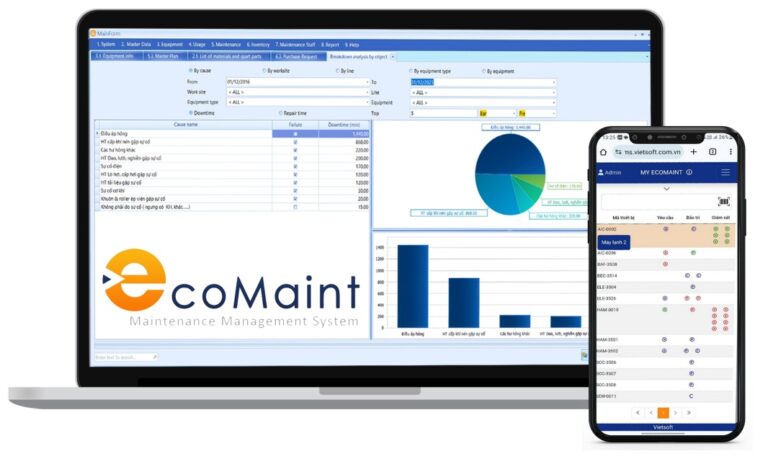
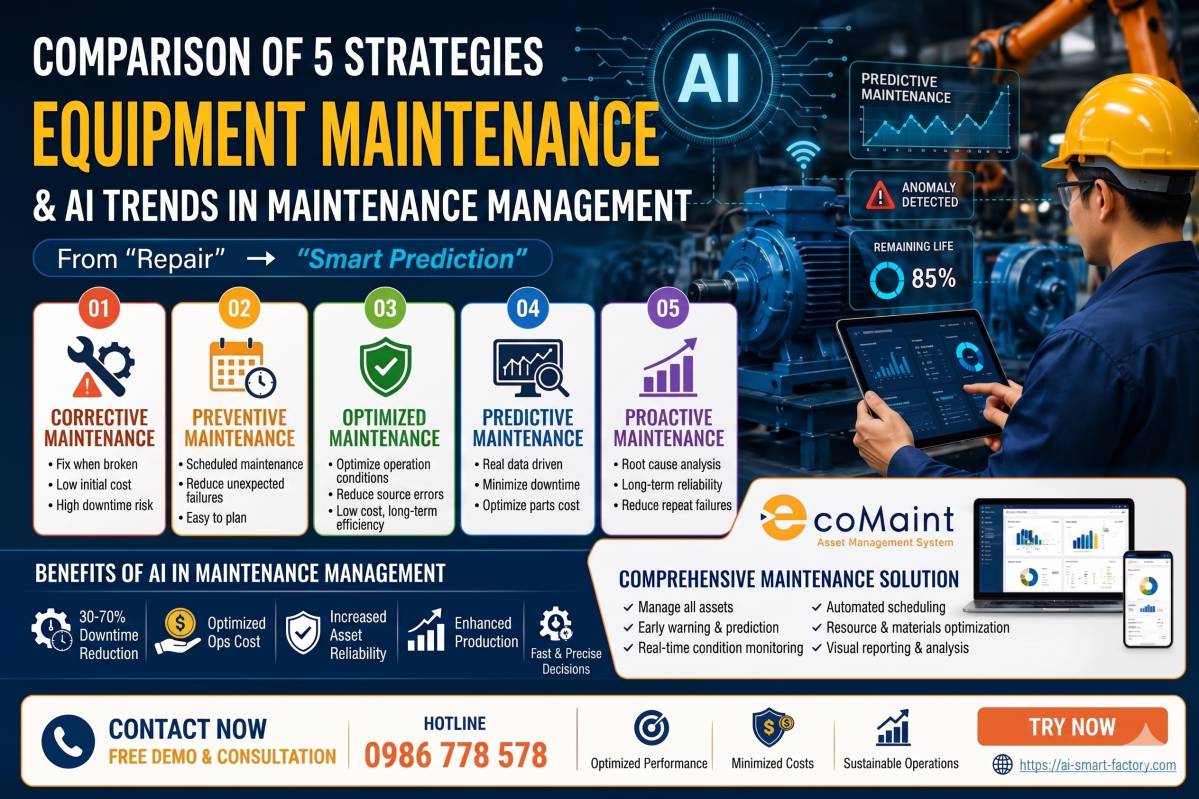
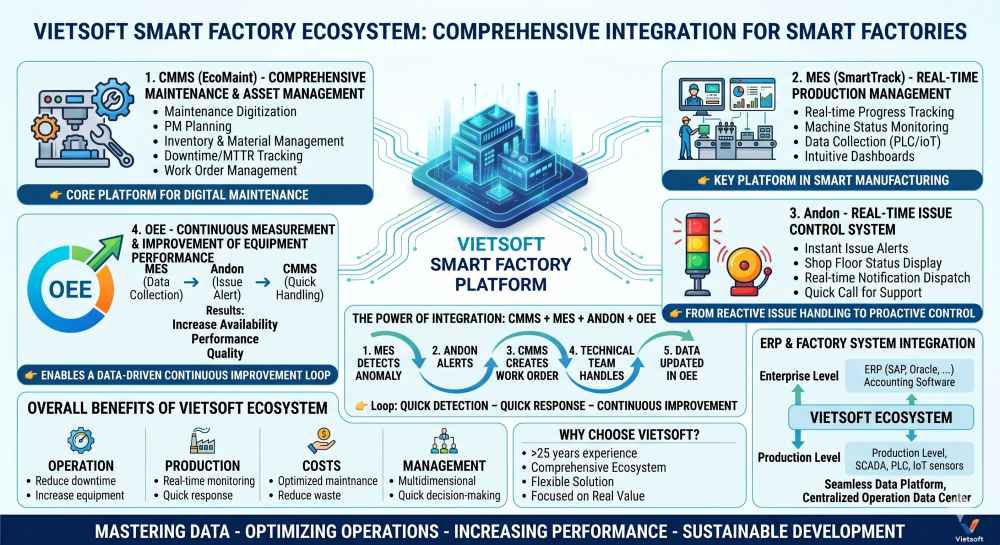
Implementing Total Productive Maintenance can be complex, but tools like CMMS EcoMaint by Vietsoft simplify the process. This robust software streamlines maintenance operations by:
- Scheduling and Tracking: Automates maintenance schedules and tracks tasks, ensuring timely execution.
- Data Analysis: Provides real-time OEE insights and failure reports to guide decision-making.
- Inventory Management: Forecasts MRO inventory needs, preventing delays due to part shortages.
- Documentation: Stores SOPs, checklists, and maintenance histories for easy access.
- Integration: Supports condition monitoring sensors for predictive maintenance, aligning with Industry 4.0 trends.
By integrating CMMS EcoMaint, organizations can enhance TPM implementation, reduce downtime, and improve OEE. Curious about how CMMS EcoMaint can transform your maintenance strategy? Learn more about CMMS EcoMaint here.
Contact us via hotline: 0986778578 or email: sales@vietsoft.com.vn.
VIII. Benefits of Total Productive Maintenance
Implementing TPM yields significant benefits, including:
- Fewer Breakdowns: Proactive maintenance reduces unexpected failures, boosting uptime.
- Lower Costs: Improved OEE reduces repair and downtime expenses.
- Safer Workplaces: The 5S methodology and safety focus minimize risks.
- Higher Quality: Early defect detection reduces waste and rework.
- Engaged Workforce: Empowering employees fosters ownership and collaboration.
Case Study: A Vietnamese textile factory implemented TPM with CMMS EcoMaint, achieving a 15% OEE increase and a 20% reduction in maintenance costs within six months.
IX. Challenges and Solutions in TPM Implementation
While TPM offers substantial benefits, challenges may arise:
- Resistance to Change: Employees may resist new responsibilities. Solution: Provide comprehensive training and communicate benefits clearly.
- Resource Constraints: Initial costs for training and software can be high. Solution: Start with a pilot area to demonstrate ROI.
- Data Overload: Tracking OEE and losses can be overwhelming. Solution: Use CMMS tools to automate data collection and analysis.
X. Total Productive Maintenance in the Era of Industry 4.0
As manufacturing evolves with Industry 4.0, TPM adapts by leveraging digital technologies:
- IoT and Sensors: Real-time monitoring detects issues before they cause failures.
- Predictive Analytics: Data-driven insights optimize maintenance schedules.
- Digital SOPs: Interactive guides improve operator training and reduce errors.
- Remote Support: Online training and support enhance accessibility.
CMMS EcoMaint integrates these technologies, making TPM more effective and scalable.
XI. Conclusion: Achieving Perfect Production with TPM
Total Productive Maintenance, born from the innovative work of Seiichi Nakajima and refined over decades, is a proven strategy for optimizing equipment reliability, reducing costs, and enhancing workplace safety. By building on the 5S foundation and leveraging the eight pillars, organizations can achieve near-perfect production. Tools like CMMS EcoMaint by Vietsoft amplify these benefits by streamlining maintenance processes and providing data-driven insights. Whether you’re a maintenance manager, technician, or operator, embracing TPM can transform your facility’s performance. Ready to take the next step? Discover CMMS EcoMaint and unlock the full potential of Total Productive Maintenance.