

In the dynamic world of industrial operations, especially across Vietnam’s thriving manufacturing and service sectors, maintaining equipment efficiency is a critical challenge. This guide draws on deep expertise in industrial maintenance and SEO strategies tailored for 2025. A CMMS Software Guide is your key to unlocking a revolutionized approach to maintenance management, offering detailed insights into what CMMS entails, how it functions, and why it’s indispensable for businesses aiming to stay competitive.
I. What is CMMS? Unraveling the Core Concept
A Computerized Maintenance Management System (CMMS) is a sophisticated software platform designed to streamline the oversight of maintenance activities within an organization. It serves as a digital backbone for managing equipment, facilities, and assets by automating routine tasks, tracking performance, and providing data-driven decision-making tools. For industries like manufacturing, healthcare, and energy—where downtime can lead to significant financial losses—CMMS acts as a game-changer by shifting maintenance from reactive firefighting to proactive planning.
Consider a typical scenario in a Vietnamese factory: a critical machine fails unexpectedly, halting production and incurring costs. Without a CMMS, identifying the root cause or assigning a skilled technician could take hours, relying on fragmented records or manual logs. With a CMMS, historical data, real-time updates, and automated work orders enable rapid response, minimizing disruption. This system isn’t merely a tool; it’s a strategic partner that enhances asset longevity, boosts safety, and supports regulatory adherence, making it essential for modern enterprises.
II. How CMMS Systems Operate: The Mechanics of Efficiency
A CMMS Software Guide reveals that these systems are built on a foundation of four interconnected elements, each playing a vital role in optimizing maintenance workflows:
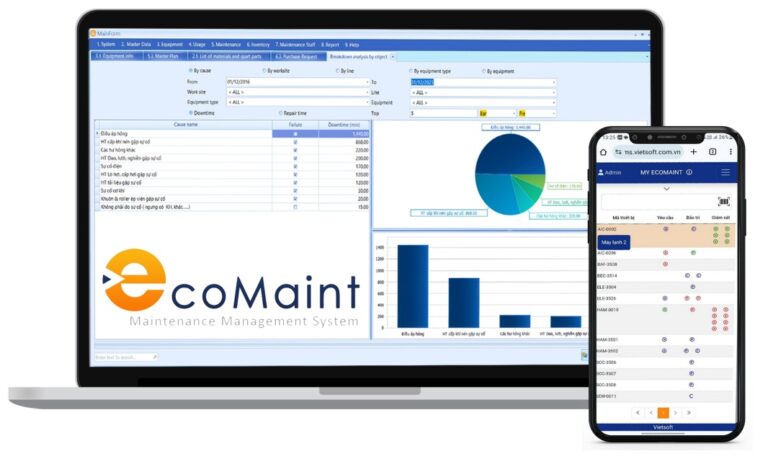
- User Interfaces: These are the frontline of interaction, accessible through desktops, tablets, or smartphones. Technicians can input equipment details, generate work orders, assign tasks, monitor inventory levels, and communicate with teams—all from a single interface. For a maintenance crew working across multiple sites in Vietnam, this mobility ensures seamless coordination.
- Reporting Dashboards: These dashboards synthesize vast amounts of data into actionable insights. For example, a manager might analyze a report showing a 30% increase in repair costs for a specific asset over the past year, prompting a decision to invest in a replacement or upgrade. Such visibility helps pinpoint inefficiencies and guide strategic planning.
- Administrative Settings: This feature allows system administrators to tailor the platform to their needs, setting user permissions, designing work order templates, and applying filters to streamline data access. This customization ensures that only relevant personnel handle sensitive tasks, enhancing security and efficiency.
- Cloud-Based Databases: Moving away from traditional on-premises servers, modern CMMS systems leverage cloud technology for unlimited scalability, robust data security, and redundancy. This is particularly beneficial for businesses with distributed operations, ensuring data is accessible anytime, anywhere.
Together, these components create a cohesive system that transforms raw data into a powerful tool for maintenance excellence, adaptable to the unique demands of any industry.
III. The Compelling Benefits of Adopting CMMS
Implementing a CMMS Software Guide into your operations yields a multitude of benefits, directly impacting the bottom line and operational smoothness. Here’s a deeper look at how it elevates maintenance management:
- Minimizing Downtime: With global economic pressures driving intense production schedules, unplanned outages can be devastating. CMMS enables preventive maintenance strategies—scheduling regular checks on assets like motors or pumps—reducing downtime by up to 20%, as supported by industry studies. This proactive approach keeps production lines humming.
- Cost Efficiency: Hidden costs, such as overtime labor or lost production due to delays, can erode profits. By optimizing inventory management and reducing emergency repairs, CMMS can lower maintenance, repair, and operational (MRO) costs by approximately 17.8%, according to A.T. Kearney research. This financial relief is a lifeline for tight budgets.
- Increased Transparency: Maintenance software shines a light on performance gaps. For instance, a CMMS dashboard might reveal that a particular machine consistently underperforms, allowing managers to adjust maintenance schedules or replace parts before major failures occur. This accountability fosters continuous improvement.
- Regulatory Compliance and Safety: Industries like pharmaceuticals or food processing face stringent regulations. CMMS maintains digital records of all maintenance activities, ensuring compliance with safety standards and simplifying audits. This not only avoids penalties but also creates a safer working environment by addressing potential hazards proactively.
For a technician, this means less time troubleshooting and more time on meaningful repairs. For managers, it translates into clear, data-backed strategies to enhance operational resilience.
IV. CMMS vs. EAM: Decoding the Differences
A common point of confusion is the distinction between CMMS and Enterprise Asset Management (EAM) systems. A CMMS Software Guide clarifies that while both support asset management, their focus and scope diverge. CMMS is tailored to maintenance-specific tasks—scheduling preventive maintenance, managing work orders, and tracking inventory—making it ideal for teams focused on day-to-day operations. EAM, conversely, encompasses the entire asset lifecycle, from acquisition to disposal, integrating with financial systems for budgeting and compliance.
For a small-scale operation, CMMS is sufficient; larger organizations with complex asset portfolios may benefit from EAM’s broader capabilities. Modern CMMS platforms, like CMMS EcoMaint, are bridging this gap by incorporating some EAM features, offering versatility for growing businesses.
|
Aspect |
CMMS |
EAM |
|
Scope |
Focuses on maintenance tasks and operations |
Covers comprehensive asset lifecycle management |
|
Functionality |
Includes scheduling, work orders, and inventory tracking |
Encompasses budgeting, compliance, and procurement |
|
User Base |
Targets maintenance teams and technicians |
Serves managers, executives, and operations staff |
|
Integration |
Offers limited integration with business systems |
Integrates seamlessly with ERP, finance, and procurement tools |
|
Use Case |
Optimizes maintenance workflows for efficiency |
Provides holistic asset and lifecycle planning |
|
Use Case |
Provides holistic asset and lifecycle planning |
|
V. Essential Features of a Top-Tier CMMS
To maximize the value of a CMMS Software Guide, selecting a system with the right features is crucial. Here are the must-haves, enriched with practical applications:
- Work Order Management: This automates the creation, assignment, and tracking of maintenance tasks. For example, a technician can receive an urgent work order for a leaking valve, complete it, and log the details—all within the system—ensuring no task slips through the cracks.
- Preventive Maintenance Scheduling: By setting schedules based on usage metrics or time intervals, CMMS prevents breakdowns. A generator might be serviced every 500 hours of operation, extending its life and avoiding unexpected failures.
- Asset Tracking: A digital repository stores critical details—serial numbers, installation dates, and repair histories—enabling quick access to asset performance trends. This helps decide whether to repair or replace an aging compressor.
- Inventory Control: Real-time monitoring of spare parts prevents stockouts. If a warehouse notices low levels of a critical gasket, the system can trigger a reorder, keeping maintenance on track.
- Mobile Accessibility: Field technicians can update statuses or upload photos of equipment issues directly from their devices, a boon for remote sites where instant communication is vital.
Advanced features like condition-based monitoring, using IoT sensors to predict failures, add another layer of sophistication, making CMMS a forward-thinking solution.
VI. Navigating Implementation Challenges
Rolling out a CMMS can encounter obstacles, but with strategic planning, these can be overcome. Common issues include:
- Lack of Executive Support: Without leadership buy-in, projects falter. Presenting a projected ROI—ranging from 25% to 300% in the first year, as seen with some implementations—can secure commitment. Educating leaders on the long-term benefits of reliability is key.
- Team Resistance: Technicians accustomed to manual methods may resist change. Involving them early in the selection process and highlighting eased workloads can foster acceptance.
- Data Migration: Transferring legacy data into a new system requires accuracy. Conducting a pre-implementation audit to clean and organize data ensures a smooth transition.
- Training Gaps: Poor training leads to underutilization—up to 90% in some cases. Comprehensive, hands-on sessions tailored to user roles can bridge this gap, ensuring the system’s full potential is realized.
A phased approach, starting with a pilot on a single asset category, allows teams to refine processes before a full rollout, minimizing disruption.
VII. Measuring Success: Calculating ROI with Precision
Demonstrating the financial impact of CMMS is essential for justifying investment. The ROI formula is straightforward:
- ROI = (CMMS Value – CMMS Cost) / CMMS Cost
- CMMS Value: Aggregates savings from five areas:
1. Asset Life: Estimate extended life (e.g., 2 extra years for a $25,000 machine) and convert to savings.
2. Downtime: Calculate lost revenue from outages (e.g., $5,000/day for 5 days = $25,000 annually).
3. Parts Inventory: Reduce waste from overstocking or emergency orders (e.g., $10,000 saved).
4. Labor Costs: Cut overtime expenses (e.g., $5,000 less per year).
5. Safety/Compliance: Avoid fines (e.g., $5,000 saved).
-
-
- Total Value Example: $25,000 + $25,000 + $10,000 + $5,000 + $5,000 = $70,000.
-
-
- CMMS Cost: Includes software, training, and implementation (e.g., $10,000).
- ROI Calculation: ($70,000 – $10,000) / $10,000 = 600%.
This example illustrates a sixfold return, a compelling case for stakeholders. Regular reviews of these metrics ensure ongoing value.
VIII. Evaluating CMMS Solutions: A Strategic Approach
Choosing the right CMMS Software Guide requires due diligence. Here’s how to assess options:
- Define Needs: List specific challenges—e.g., frequent downtime or inventory issues—and match them to features like mobile access or analytics.
- Prioritize User Adoption: Seek systems with high adoption rates. Ask vendors for case studies or trial periods to test usability with your team.
- Embrace Mobile-First Design: For teams spread across large facilities, mobile apps with chat functionality (like CMMS EcoMaint’s) enhance communication and reduce errors.
- Focus on Reporting: Ensure the system translates data into meaningful metrics—e.g., Mean Time to Repair (MTTR) or asset uptime—avoiding “data black holes.”
- Assess ROI Potential: Compare projected costs against expected savings, considering training and integration expenses.
Testing the software with your team before committing ensures it aligns with operational realities.
IX. Introducing CMMS EcoMaint: Vietsoft’s Tailored Solution
For businesses in Vietnam, Vietsoft’s CMMS EcoMaint offers a localized edge. Designed with the region’s industrial landscape in mind, it provides intuitive mobile access, real-time analytics, and seamless integration with existing systems. Whether managing a textile mill or a power plant, this solution streamlines workflows, reduces downtime, and enhances team collaboration. Intrigued by its potential to transform your maintenance strategy? Discover CMMS EcoMaint here.
Contact us via hotline: 0986778578 or email: sales@vietsoft.com.vn.
X. Conclusion: Embracing the Future of Maintenance
A CMMS Software Guide is more than an instructional resource—it’s a blueprint for mastering maintenance in a competitive world. By automating processes, delivering actionable insights, and fostering a proactive mindset, CMMS empowers teams to excel. From small workshops to large industrial complexes, the right system saves time, cuts costs, and ensures compliance. With Vietsoft’s CMMS EcoMaint, tailored for Vietnam’s market, the path to maintenance mastery is clear. Take the first step today and unlock your team’s potential for sustained success.