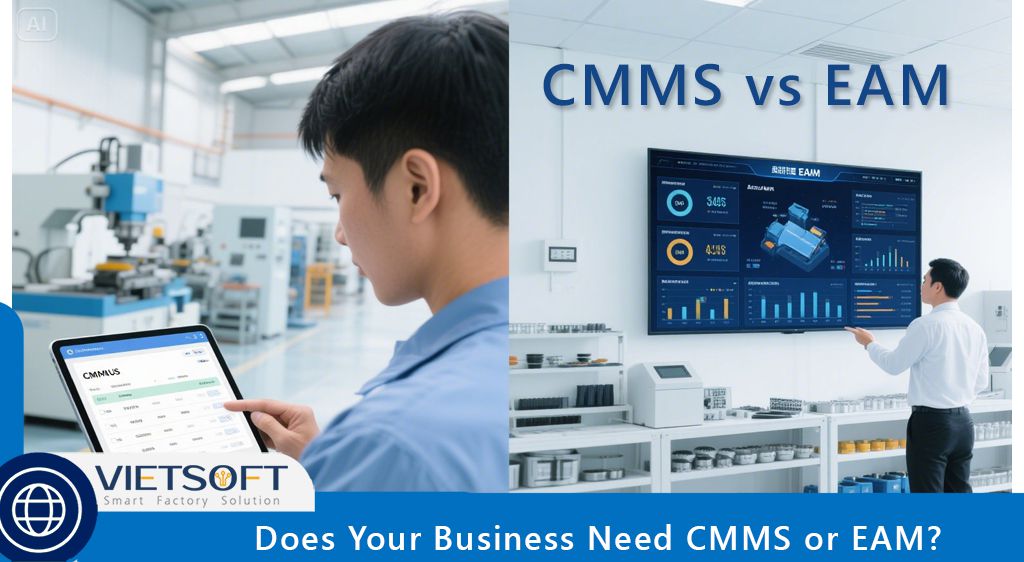
In today’s fast-paced industrial landscape, efficient asset and maintenance management is critical for businesses aiming to minimize downtime, optimize resources, and stay competitive. For companies in Vietnam and beyond, the decision to adopt a Computerized Maintenance Management System (CMMS) or an Enterprise Asset Management (EAM) system can be a game-changer. But does your business need CMMS or EAM? This article dives deep into the roles, features, benefits, and practical applications of both systems, offering actionable insights for maintenance professionals and business leaders. This guide is tailored to help you make an informed decision.
I. What Are CMMS and EAM? Understanding the Basics
To determine whether your business needs CMMS or EAM, it’s essential to understand their core functionalities and how they differ.
1. What Is a CMMS?
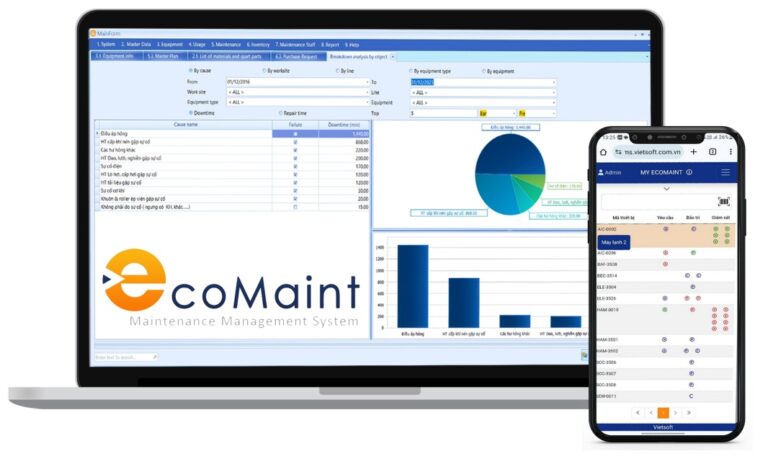
A Computerized Maintenance Management System (CMMS) is a software solution designed to streamline maintenance operations. It focuses on organizing and automating tasks such as work order management, preventive maintenance scheduling, inventory tracking, and equipment history logging. Originally developed to replace paper-based systems, modern CMMS platforms like EcoMaint leverage cloud technology, mobile accessibility, and AI-driven analytics to enhance operational efficiency.
For example, a manufacturing plant using a CMMS can schedule regular inspections for its machines, track spare parts inventory, and monitor repair histories—all from a centralized platform. This ensures equipment runs smoothly, reducing unexpected breakdowns that could halt production.
2. What Is an EAM?
An Enterprise Asset Management (EAM) system takes a broader approach, managing the entire lifecycle of physical assets—from acquisition to disposal. While it includes CMMS functionalities, EAM extends to financial management, strategic planning, compliance tracking, and multi-site operations. EAM systems are ideal for organizations with complex asset portfolios or multiple facilities, such as a logistics company managing warehouses across Ho Chi Minh City, Da Nang, and Hai Phong.
For instance, an EAM system could track the depreciation of a fleet of delivery trucks, optimize maintenance schedules across multiple locations, and integrate with accounting software to manage costs—all while ensuring regulatory compliance.
3. Key Similarities Between CMMS and EAM
While CMMS and EAM serve different scopes, they share common goals:
- Reduce Downtime: Both systems prioritize preventive maintenance to avoid costly equipment failures.
- Enhance Efficiency: They automate manual processes, freeing up time for maintenance teams.
- Data-Driven Decisions: Both provide insights into asset performance and maintenance trends.
- Improve Asset Longevity: Regular maintenance extends the lifespan of critical equipment.
However, the choice between CMMS and EAM depends on your business’s scale, complexity, and strategic objectives.
II. Why Does Your Business Need CMMS or EAM?
The question “Does your business need CMMS or EAM?” often arises when companies face challenges like unexpected downtime, inefficient workflows, or rising maintenance costs. According to industry data, manufacturers experience an average of 800 hours of downtime annually, costing approximately $17,000 per incident. Implementing the right system can address these pain points and deliver measurable benefits.
1. The Business Case for CMMS
A CMMS is ideal for businesses focused on optimizing maintenance operations without the need for extensive asset lifecycle management. Here’s why your business might need a CMMS:
· Streamlined Work Order Management: CMMS systems allow you to create, assign, and track work orders digitally. For example, a food processing plant can assign a technician to repair a conveyor belt, log the time spent, and document parts used—all in real time.
· Proactive Preventive Maintenance: By scheduling routine tasks (e.g., monthly motor inspections), a CMMS reduces unexpected breakdowns. This is critical for small to medium-sized businesses in Vietnam, where every hour of downtime impacts revenue.
· Inventory Optimization: CMMS tracks spare parts, preventing stockouts or overstocking. For instance, a factory can set reorder alerts for critical components like bearings, avoiding production delays.
· Cost Savings: By catching issues early, a CMMS minimizes repair costs and extends equipment life. A study showed that preventive maintenance can reduce maintenance costs by up to 30%.
· Compliance and Audits: CMMS maintains detailed records, ensuring readiness for regulatory audits, which is vital for industries like pharmaceuticals or oil and gas.
2. The Business Case for EAM
An EAM system suits businesses with complex operations or multiple sites, offering a holistic approach to asset management. Here’s why your business might need an EAM:
· Full Asset Lifecycle Management: EAM tracks assets from purchase to disposal, optimizing their total cost of ownership (TCO). For example, a construction company can monitor the lifecycle of heavy machinery, deciding when to repair or replace based on cost data.
· Multi-Site Coordination: EAM systems manage assets across multiple locations, ideal for businesses with distributed operations, such as retail chains or logistics firms.
· Financial Integration: EAM links maintenance data with financial systems, providing insights into budgeting and capital planning. For instance, a utility company can forecast maintenance costs for its power grid.
· Strategic Decision-Making: EAM’s advanced analytics help identify underperforming assets, enabling data-driven decisions. A hospital, for example, can use EAM to prioritize maintenance for critical equipment like MRI machines.
· Regulatory Compliance: EAM ensures adherence to industry standards, such as ISO 55000, by tracking compliance across all assets.
III. When Does Your Business Need CMMS or EAM?
1. Choose CMMS If:
-
- Your business focuses on maintenance efficiency for a single site or a limited number of assets.
- You need a cost-effective solution to manage work orders, preventive maintenance, and spare parts.
- Your team is small, and simplicity is a priority. For example, a small manufacturing firm in Binh Duong might opt for a CMMS like EcoMaint to manage its production line.
2. Choose EAM If:
-
- Your organization manages a large, diverse asset portfolio across multiple locations.
- You require integration with financial, procurement, or project management systems.
- Strategic planning and compliance are critical. For instance, a multinational company with factories in Vietnam and Thailand might need an EAM to coordinate global operations.
IV. Key Features of CMMS and EAM for Businesses
To understand whether your business needs CMMS or EAM, let’s explore their core features and how they address real-world challenges.
1. Core Features of a CMMS
· Work Order Management: Create, assign, and track work orders with details like task descriptions, priorities, and required parts. For example, a technician can receive a mobile notification to repair a pump, complete with instructions and part lists.
· Preventive Maintenance Scheduling: Automate recurring tasks based on time (e.g., monthly) or usage (e.g., every 1,000 operating hours). This ensures equipment like HVAC systems in a hotel are serviced before failures occur.
· Asset Tracking: Maintain a database of equipment details, including make, model, and maintenance history. A warehouse can use this to monitor forklift performance and plan replacements.
· Inventory Management: Track spare parts and set reorder thresholds. For instance, a packaging plant can avoid delays by ensuring adhesive supplies are always available.
· Reporting and Analytics: Generate reports on downtime, maintenance costs, and task completion rates. A factory can identify high-maintenance machines and justify replacements based on data.
2. Core Features of an EAM
· Lifecycle Management: Monitor assets from acquisition to disposal, optimizing their TCO. For example, a shipping company can track the lifecycle of its vessels, balancing maintenance costs against replacement.
· Multi-Site Management: Coordinate maintenance across multiple facilities. A retail chain can manage HVAC systems across stores in different cities from a single platform.
· Financial Integration: Link maintenance data to budgeting and forecasting tools. A power plant can use EAM to allocate maintenance budgets based on asset performance.
· Advanced Analytics: Use KPIs to identify trends and inefficiencies. For instance, a chemical plant can analyze pump failure rates to optimize maintenance schedules.
· Compliance Tools: Ensure adherence to regulations like ISO 55000 or local safety standards, critical for industries like oil and gas or healthcare.
3. Emerging Features in Modern Systems
Advancements in technology have blurred the lines between CMMS and EAM, making the decision more nuanced:
- AI and Predictive Maintenance: Both systems now incorporate AI to predict equipment failures based on usage patterns. For example, a CMMS can alert a factory to replace a motor before it fails.
- IoT Integration: Sensors on equipment feed real-time data to CMMS or EAM systems, enabling proactive maintenance. A water treatment plant can monitor pump vibrations to schedule timely repairs.
- Mobile Accessibility: Both systems offer mobile apps, allowing technicians to access work orders and update tasks from the field, improving efficiency.
V. Benefits of Implementing CMMS or EAM
Understanding the tangible benefits of CMMS and EAM helps clarify whether your business needs one.
1. Benefits of CMMS
- Reduced Downtime: Preventive maintenance minimizes unexpected failures, ensuring continuous production. For example, a garment factory can avoid costly delays by servicing sewing machines regularly.
- Cost Efficiency: Early issue detection reduces repair costs. A CMMS can save up to 30% on maintenance expenses by preventing major breakdowns.
- Improved Team Productivity: Automated work orders and schedules free up technicians for critical tasks. A small maintenance team can manage more assets efficiently.
- Organized Data: Centralized records eliminate paper-based chaos, making audits and troubleshooting easier.
- Scalability: Modern CMMS solutions like EcoMaint can scale with growing businesses, adding features as needed.
2. Benefits of EAM
- Holistic Asset Management: EAM optimizes the entire asset lifecycle, reducing TCO. A construction firm can decide whether to repair or replace a crane based on lifecycle data.
- Enhanced Visibility: Real-time insights across multiple sites improve coordination. A logistics company can monitor truck maintenance across Vietnam from one dashboard.
- Strategic Planning: EAM aligns maintenance with business goals, such as budgeting for new equipment or meeting sustainability targets.
- Compliance and Risk Management: EAM ensures regulatory compliance, reducing legal risks in industries like energy or healthcare.
- Cross-Department Integration: EAM connects maintenance with finance, procurement, and HR, streamlining operations.
VI. How to Choose Between CMMS and EAM for Your Business
Deciding whether your business needs CMMS or EAM requires a thorough evaluation of your operational needs, budget, and goals.here are some Key Considerations:
1. Business Size and Complexity:
o Small to Medium Businesses: A CMMS is often sufficient for single-site operations with straightforward maintenance needs. For example, a local packaging company can use a CMMS to manage its machinery efficiently.
o Large or Multi-Site Businesses: EAM is better suited for complex operations across multiple locations, such as a national retail chain managing store facilities.
2. Budget:
o CMMS systems are generally more affordable, with SaaS models offering low upfront costs. For instance, EcoMaint provides flexible pricing for Vietnamese SMEs.
o EAM systems involve higher costs due to their advanced features but offer greater ROI for large organizations.
3. Scalability:
o Choose a CMMS if you need a simple, scalable solution that can grow with your business.
o Opt for EAM if you anticipate significant expansion or need advanced features like financial integration.
4. Ease of Use:
o CMMS platforms prioritize user-friendliness, ideal for small teams with limited training time.
o EAM systems may require more training but offer comprehensive tools for complex operations.
5. Integration Needs:
o If you need integration with accounting or ERP systems, EAM is the better choice.
o A CMMS is sufficient if maintenance is your primary focus.
VII. Common Pitfalls to Avoid When Implementing CMMS or EAM
Implementing a CMMS or EAM system requires careful planning to ensure success. Here are common pitfalls to avoid:
· Choosing Overly Complex Software: A feature-heavy system may overwhelm a small team. Opt for simplicity unless advanced features are essential.
· Underestimating Setup Time: Entering asset data and configuring schedules takes time. Allocate resources for proper setup.
· Lack of Team Buy-In: Involve technicians early to ensure adoption. Explain how the system simplifies their work.
· Poor Data Quality: Start with accurate asset information to avoid “garbage in, garbage out” issues.
· Ignoring Mobile Needs: Ensure the system’s mobile app is user-friendly and supports field operations.
VIII. Introducing EcoMaint: A Tailored CMMS Solution for Vietnamese Businesses
For businesses in Vietnam seeking a reliable, user-friendly CMMS, EcoMaint by Vietsoft offers a compelling solution. Designed with the needs of SMEs and growing enterprises in mind, EcoMaint streamlines work order management, preventive maintenance, and inventory tracking while being cost-effective and scalable. Its cloud-based platform and mobile app ensure accessibility, making it ideal for maintenance teams on the go. Curious about how EcoMaint can transform your maintenance operations? Learn more about CMMS EcoMaint here.
Contact us for consultation via hotline: 0986778578 or email: sales@vietsoft.com.vn.
IX. Conclusion: Making the Right Choice for Your Business
Deciding whether your business needs CMMS or EAM is a pivotal step toward operational excellence. A CMMS like EcoMaint is perfect for businesses focused on efficient maintenance, cost savings, and simplicity, especially for single-site operations or SMEs. An EAM system is better suited for organizations with complex, multi-site operations requiring lifecycle management and strategic integration. By assessing your needs, testing solutions, and avoiding common pitfalls, you can choose a system that boosts productivity, reduces downtime, and aligns with your long-term goals.
In 2025, as Vietnamese businesses embrace digital transformation and face global competition, the right CMMS or EAM system can position you as an industry leader. Take the first step today by evaluating your options and exploring tools like EcoMaint to see how they can elevate your maintenance strategy.