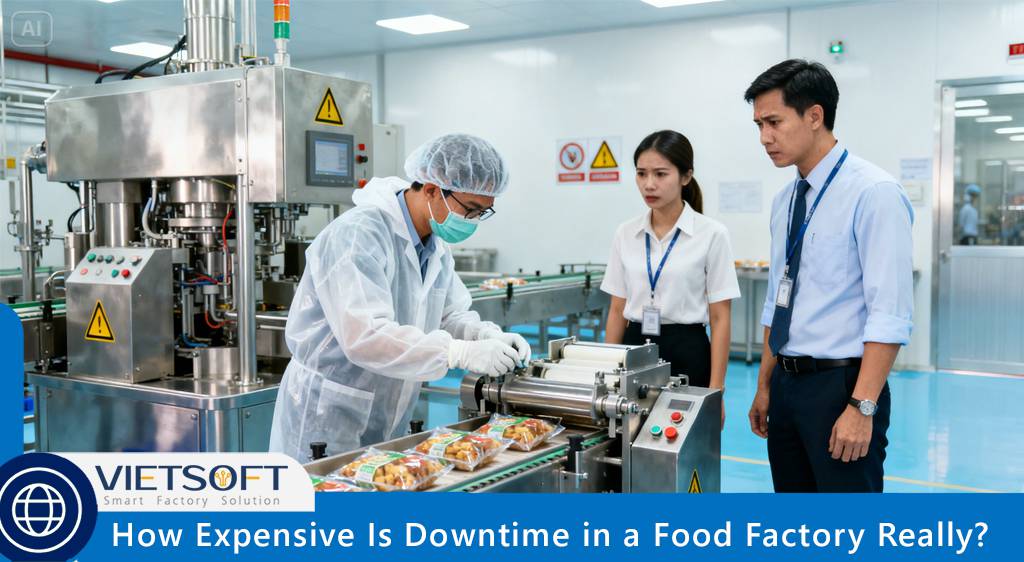
In the food industry, one minute of machine stoppage is rarely just one minute of lost production. It can mean a ruined batch, a production line that needs re-cleaning, a delayed delivery truck, an extended work shift, or even a major risk to traceability and food safety. That is why downtime in food factory operations is not only a technical issue but also a serious challenge involving finance, quality, and regulatory compliance. This article will help you clearly understand the true nature of downtime in food factory.
I. The Concept of Downtime in Food Production: More Than Just Machines Stopping
Downtime in food factory refers to the period when the production system cannot operate, including both planned downtime and unplanned downtime. Many people believe that only major breakdowns cause serious damage, but in reality, it is the small, frequent stoppages lasting just a few minutes that accumulate into enormous losses.
The unique characteristic of the food industry lies in its “continuous” and “perishable” nature. Unlike mechanical or electronic component manufacturing, when a food production line stops, the ingredients and materials currently being processed can spoil almost immediately.
Therefore, downtime in food factory is not merely a technical problem — it is a matter of survival concerning product quality, food safety, and brand reputation.
II. Why Is Downtime in Food Factory Particularly Costly?
Not every manufacturing sector is affected equally when a production line stops. In the food industry, the level of damage is often much higher due to perishable raw materials, strict cleaning requirements, and high traceability standards.
1. Lost Production Is Only the Tip of the Iceberg
The most obvious cost is lost output. When the line stops, products are not made, orders cannot be shipped on time, and revenue is impacted immediately.
However, this is only the most visible part.
2. Waste of Raw Materials and Work-in-Progress
In a food factory, raw materials and semi-finished products are highly sensitive to temperature, time, humidity, and hygiene conditions. A prolonged stoppage can lead to:
- Raw materials exceeding allowable time on the line
- Semi-finished products losing quality
- Finished goods having to be discarded for failing standards
- The need to re-clean the entire area after restarting the line
This means the damage comes not only from “not producing” but also from “what has already been produced but can no longer be used.”
3. Ongoing Labor Costs Continue to Accumulate
When the line is down, operators, quality control staff, maintenance teams, warehouse personnel, logistics teams, and shift supervisors are still present. They continue to receive wages while generating no corresponding value. In addition, the company may have to pay overtime to catch up on the schedule.
In factories where multiple lines are interconnected, downtime at one point can cause other departments to fall into a waiting state.
4. Restart Costs Are Often Underestimated
Restarting a food production line is not as simple as flipping a switch. Many lines require:
- Hygiene condition verification
- Operating parameter confirmation
- Machine recalibration
- Trial runs
- First-batch sample testing
- Discarding the initial startup batch if it is unstable
As a result, restart costs can be very high, especially on high-speed or continuous processing lines.
5. Delivery Risks and Supply Chain Disruptions
A few hours of downtime can delay the entire day’s shipment schedule. This leads to:
- Trucks waiting at the loading dock
- Warehouse rescheduling
- Delayed customer deliveries
- Emergency shipping costs
- Risk of penalties under SLA or contract terms
In the food industry, delivery delays also affect product shelf life, especially for chilled, fresh, or short-shelf-life items.
6. Quality and Compliance Risks
This is the factor that makes downtime in food factory far more expensive than in other industries. When the system stops, the company may lose traceability data, temperature logs, batch history, CCP records, cleaning records, or maintenance records. If the stoppage occurs during an internal audit, customer audit, or regulatory inspection, the consequences can be far more severe than the cost of repairs alone.
7. Brand Damage and Internal Pressure
A single small incident rarely causes a factory to lose customers. However, when downtime occurs repeatedly, the cumulative impact becomes evident:
- Customers lose confidence in supply reliability
- Operations teams fall into constant firefighting mode
- Employees become fatigued, leading to more errors
- Managers struggle to plan production accurately
- Hidden costs continue to grow but are difficult to see in short-term financial reports
III. The Hidden Layers of Costs in Downtime in Food Factory
To evaluate downtime correctly, it must be viewed across multiple cost layers rather than just “how much one hour costs.”
1. Layer 1: Direct Costs Include:
- Lost production output
- Repair costs
- Emergency technical costs
- Replacement of materials and spare parts
- Labor costs for idle time or overtime
2. Layer 2: Semi-Direct Costs Include:
- Spoiled or discarded goods
- Wasted raw materials
- Energy consumption during stoppage and restart
- Re-cleaning costs
- Line re-setup time
3. Layer 3: Indirect Costs Include:
- Delayed deliveries
- Supply chain impacts
- Lost sales opportunities
- Pressure on planning departments
- Overall reduced efficiency
4. Layer 4: Risk Costs Include:
- Quality deviations
- Traceability failures
- Risk of failed audits
- Contract penalty risks
- Risk of losing customers
5. Layer 5: Long-Term Costs Include:
- Reduced brand reliability
- Increased staff burnout rates
- Suboptimal emergency investments
- Prolonged reactive culture
- Maintenance of inefficient maintenance models
IV. Downtime Cost Calculation Formula – From Superficial Numbers to the Full Picture
To truly understand how costly downtime in food factory is, a comprehensive calculation formula is needed.
1. Actual Downtime Cost Formula
Actual Downtime Cost = Direct Costs + (Indirect Costs × Multiplier)
Direct costs include:
- Lost production revenue = (Hourly production value) × (Downtime duration)
- Spoiled material cost = (Value of materials in process) × (Spoilage rate)
- Labor cost = (Number of affected workers) × (Hourly labor rate) × (Downtime duration)
Indirect costs are typically estimated using a multiplier of 2.0 to 2.5 times direct costs, based on research from ABB and Aberdeen Research. This multiplier accounts for emergency repair costs, traceability losses, compliance costs, and brand reputation impact.
2. Real-World Example – A 4-Hour Stoppage at a Medium-Sized Food Factory
Assume a mid-sized food processing and export factory with the following data:
- Hourly production revenue: 900 USD (approx. 25 million VND)
- Affected workers: 50 people
- Average hourly wage: 1.8 USD (approx. 50,000 VND)
- Value of spoiled materials in process: 5,000 USD (approx. 125 million VND)
Direct costs:
- Lost revenue: 900 USD × 4 hours = 3,600 USD (approx. 100 million VND)
- Material waste: 5,000 USD (approx. 125 million VND)
- Labor cost: 50 people × 1.8 USD × 4 hours = 360 USD (approx. 10 million VND)
Total direct costs: 8,660 USD (approx. 235 million VND)
Indirect costs (using a multiplier of 1.8): 8,660 USD × 1.8 = 15,588 USD (approx. 437 million VND)
Total actual cost: 8,660 USD + 15,588 USD = 24,248 USD (approx. 643 million VND) for just 4 hours of downtime.
This figure may shock many people, but it is the reality that many factories silently bear every time an incident occurs. If an average of 2–3 such incidents happen per month, annual losses can reach 10–15 billion VND — enough money to invest in production expansion or upgrade manufacturing equipment.
V. Root Causes of Downtime in Food Factory
Understanding the root causes is the first step toward control. Based on years of practical experience at Vietnamese food factories, Vietsoft has identified three main groups of causes:
1. Equipment and Mechanical Causes
This group accounts for the largest share, up to 32% according to food manufacturing industry statistics. Typical culprits include:
- Inappropriate bearings: In environments with strong chemical washing and high water pressure, standard bearings quickly corrode, lose lubrication, and fail.
- Motors and gearboxes affected by chemicals: Food factory cleaning environments often use strong alkaline or acidic detergents. These substances can penetrate rotating parts and cause rapid corrosion and damage if equipment is not specially designed.
- Sensors and control systems affected: High humidity, steam, and wash-down water can damage sensors, limit switches, and controllers if not properly protected.
2. Human and Operational Causes
People are a critical factor but also the source of 29% of downtime incidents:
- Operational errors: Incorrect procedures, wrong parameter settings, or failure to detect early warning signs.
- Insufficient training: When workers are not properly trained on equipment operation, especially advanced technology, the risk of incidents is very high.
- Shortage of experienced personnel: The manufacturing sector faces major challenges as skilled workers retire while the next generation lacks adequate training.
3. Organizational and Process Causes
Accounting for 23% of total incidents, this group usually relates to:
- Inefficient maintenance schedules: Lack of time for preventive maintenance due to production pressure, or schedules not synchronized with production plans.
- Poor spare parts management: Lack of replacement parts leads to extended waiting times, turning a small issue into a major disruption.
- Prolonged cleaning and product changeover: This is a unique feature of the food industry. CIP (Clean-In-Place) processes and production batch changeovers take significant time. If not optimized, they become “planned downtime” that still causes considerable losses.
VI. New Trends in Controlling Downtime in Food Factory
By 2026, the mindset for managing downtime in the food industry is shifting strongly toward the following trends:
1. Integrating Operational and Maintenance Data
Instead of just tracking incidents, companies are linking production, quality, energy, and maintenance data to understand exactly how much one incident truly affects the factory.
2. Focus on Operational Resilience
Rather than only reducing the number of failures, many factories now emphasize reducing recovery time, improving response capability, and having backup plans and standardized handling procedures in place.
3. IT and OT Synchronization
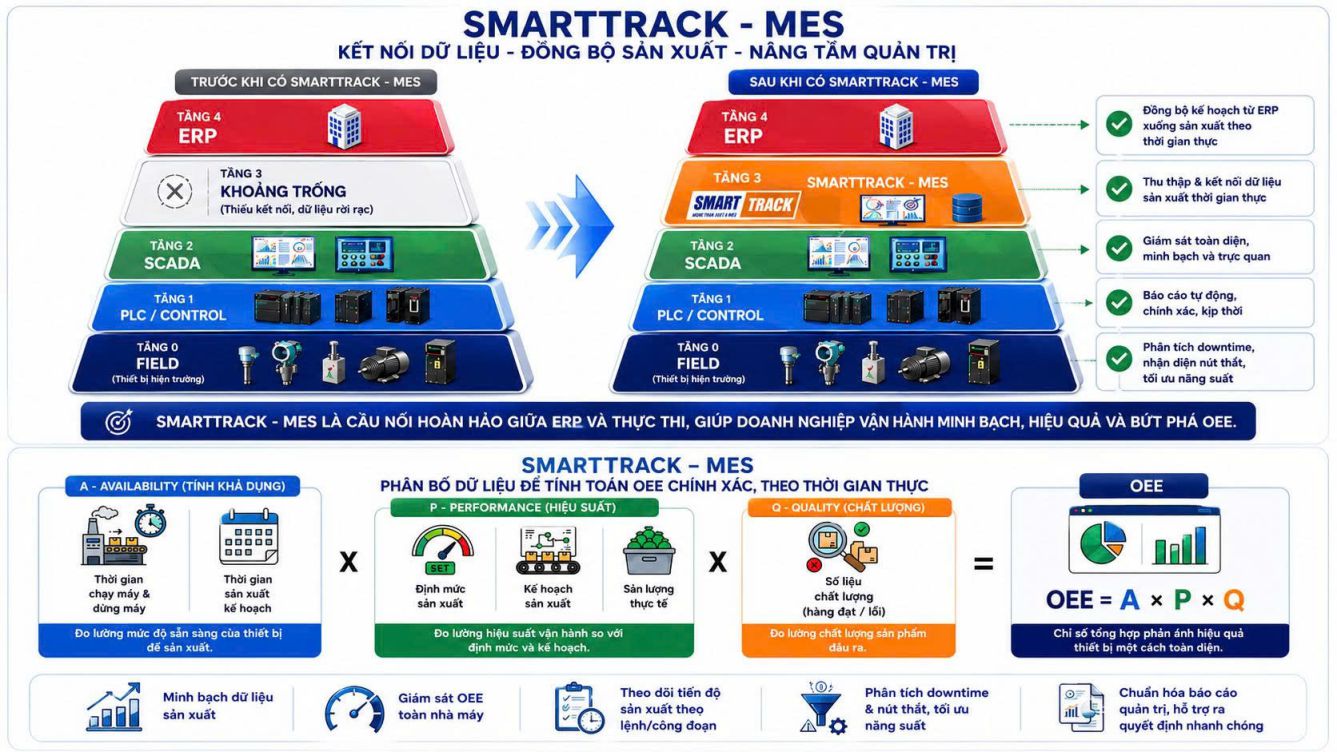
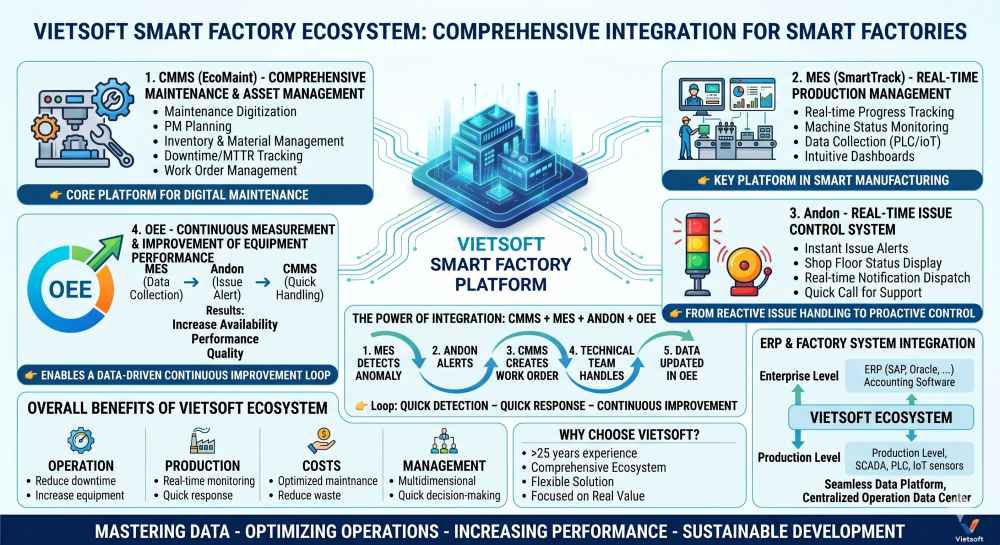
Downtime caused by digital systems is becoming increasingly important. Modern maintenance can no longer be separated from MES, ERP, SCADA, traceability systems, and industrial cybersecurity.
4. Managing Downtime as a Financial Metric
Forward-thinking companies no longer view downtime merely as a technical KPI. They convert downtime into monetary value, delivery risk, quality risk, and ROI for improvement projects.
VII. Where Should Food Industry Businesses Start Controlling Downtime?
If your factory is experiencing frequent stoppages but does not know where to begin, follow this sequence:
Step 1: Classify Downtime Clearly separate planned and unplanned downtime by equipment, line, shift, and cause.
Step 2: Identify Critical Assets Select the group of equipment that has the greatest impact on output or food safety.
Step 3: Standardize Data and Handling Procedures Every incident must have a cause code, response time, repair time, and corrective actions.
Step 4: Prioritize Quick Wins For example:
- Optimize preventive maintenance for critical assets
- Stock essential spare parts
- Reduce changeover time
- Set up anomaly alerts
- Train frontline operators
Step 5: Digitize Maintenance Management As data volume increases, manual paper-based management, fragmented Excel files, or reliance on memory will become new bottlenecks.
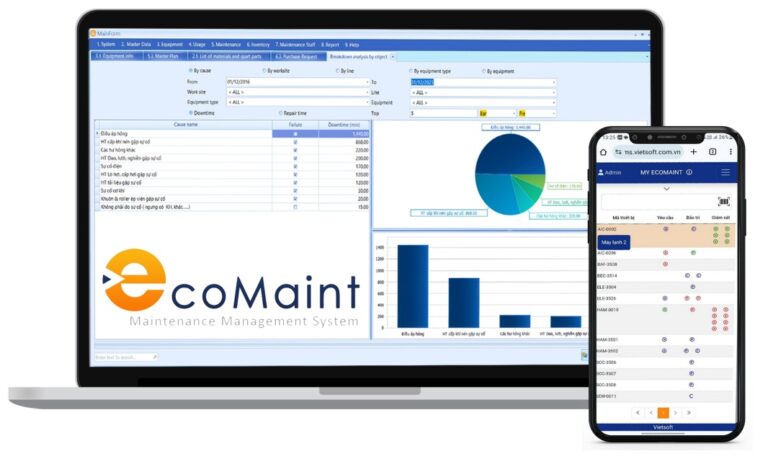
VIII. How Does the EcoMaint CMMS/EAM Solution Help Solve Downtime Reduction in the Food Industry?
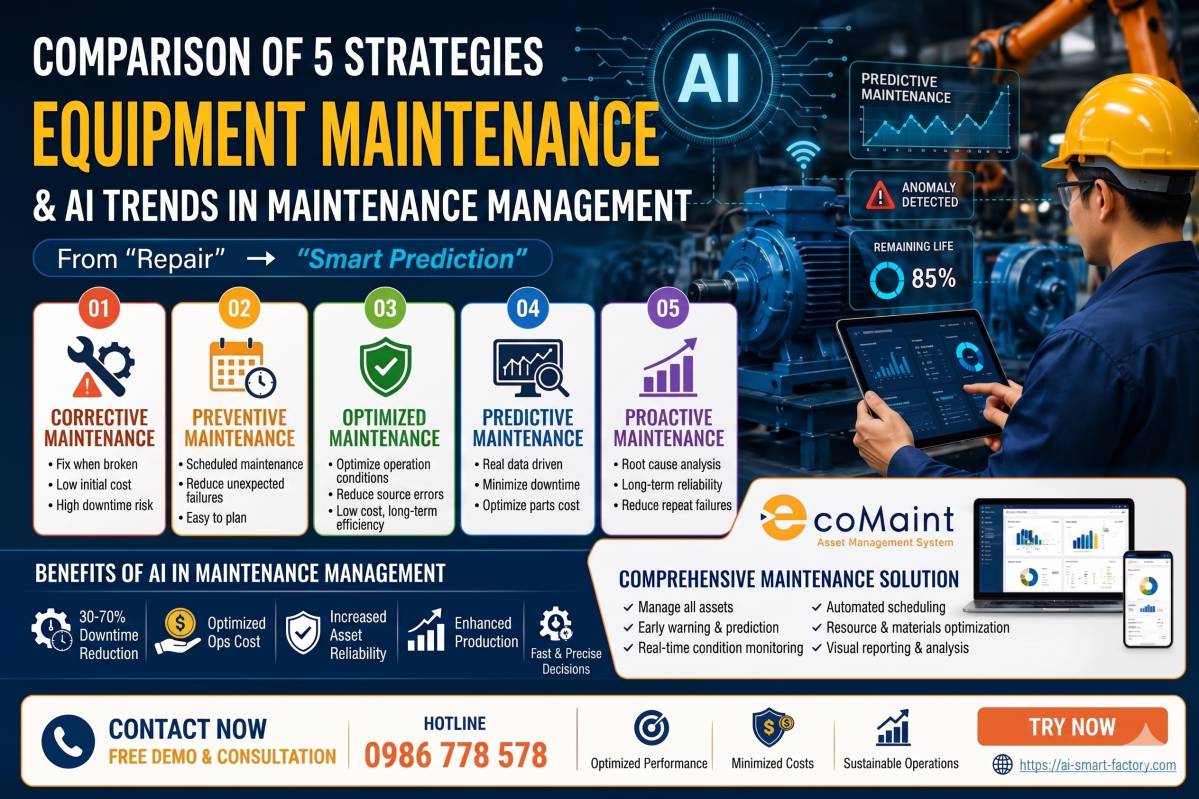
To sustainably reduce downtime in food factory, businesses need more than just a preventive maintenance schedule. The key is to control the entire maintenance work lifecycle: from incident detection, work order creation, technician coordination, material tracking, root cause recording, to trend analysis and performance evaluation.
This is also why more and more food factories are turning to CMMS maintenance management software. A good CMMS system can support:
- Planning and automating preventive maintenance schedules
- Centralized work order management
- Equipment history tracking
- Spare parts inventory management
- Analysis of MTTR, MTBF, and downtime by asset
- Recording root causes and corrective actions
- Mobile support for technicians
- Improved coordination between maintenance, production, and warehouse teams
For food factories, this is not just a tool for the technical team but a platform that helps standardize data, increase operational reliability, and support better audits.
Please Discover the CMMS EcoMaint solution here.
Contact us for consultation via hotline: +84.986778578 or email: sales@vietsoft.com.vn.