
Asset management is a cornerstone of operational efficiency, especially for businesses in industries like manufacturing, logistics, and facility management. An asset audit is a critical process that ensures your organization’s assets—whether machinery, equipment, or intangible properties—are accurately tracked, maintained, and optimized. By performing an asset audit, companies can align their records with reality, ensure compliance, and make informed strategic decisions. In this guide, we’ll dive deep into how to perform an asset audit, exploring its definition, importance, step-by-step process.
I. What is an Asset Audit?
An asset audit is a systematic process of verifying the existence, condition, and value of a company’s assets. This includes physical assets like machinery, vehicles, and tools, as well as intangible assets such as software licenses, patents, or trademarks. The goal is to ensure that the company’s asset register aligns with what is physically or digitally present, providing an accurate foundation for financial reporting, compliance, and operational planning.
II. Why Perform an Asset Audit?
Performing an asset audit serves multiple purposes:
- Accuracy in Financial Reporting: Ensures asset records match reality, critical for balance sheets, tax filings, and investor reports.
- Regulatory Compliance: Verifies that assets meet industry standards and government regulations, avoiding fines or legal issues.
- Risk Mitigation: Identifies missing, stolen, or underperforming assets, reducing financial and operational risks.
- Optimized Asset Management: Provides insights into asset utilization, maintenance needs, and lifecycle planning, improving efficiency and profitability.
III. Types of Asset Audits
Asset audits can be categorized into two primary types, each with distinct purposes and benefits:
1. Internal Asset Audits
Internal audits are conducted by a company’s own staff, typically maintenance or accounting teams. These audits focus on:
- Verifying asset records against physical inventory.
- Assessing asset condition and maintenance history.
- Identifying inefficiencies in asset utilization.
- Ensuring compliance with internal policies.
Advantages:
- Flexible scheduling and lower costs.
- Deep understanding of company processes by internal teams.
- Opportunities to improve internal workflows.
2. External Asset Audits
External audits are performed by independent third parties, such as auditing firms or regulatory bodies. They emphasize:
- Objective validation of financial records.
- Compliance with legal and industry standards.
- Transparency for stakeholders, investors, or regulators.
Advantages:
- Unbiased perspective, reducing internal bias.
- Enhanced credibility for financial reporting.
- Identification of issues overlooked by internal teams.
Internal vs. External: Internal audits offer flexibility and process improvement, while external audits ensure objectivity and regulatory compliance. Many businesses combine both for comprehensive asset management.
IV. Objectives of Performing an Asset Audit
Understanding the objectives of an asset audit helps organizations align the process with their strategic goals. Here are the key objectives:
1. Ensuring Accurate Asset Records
Accurate records are the backbone of financial and operational planning. An asset audit verifies that listed assets exist, are correctly located, and match their documented condition. This prevents errors in financial statements and supports budgeting and forecasting.
2. Tracking Asset Value and Depreciation
Assets depreciate over time due to wear, obsolescence, or market changes. An audit ensures that depreciation is accurately calculated using methods like:
- Straight-Line Method: Spreads depreciation evenly over an asset’s useful life (e.g., a $10,000 machine with a 5-year life depreciates $2,000 annually).
- Declining Balance Method: Accelerates depreciation for assets that lose value quickly.
- Units of Production Method: Ties depreciation to usage, ideal for machinery with variable output.
Accurate depreciation tracking ensures financial statements reflect true asset values, aiding tax calculations and investment decisions.
3. Preventing Asset Loss and Fraud
Regular audits identify “ghost assets” (items listed but missing) and detect potential theft or misuse. For instance, a company might find that a vehicle listed in its records was sold without proper documentation, prompting stronger controls.
4. Enhancing Operational Efficiency
By evaluating asset condition and usage, audits reveal underperforming or underutilized assets. This allows businesses to optimize maintenance schedules, reallocate resources, or dispose of obsolete equipment.
5. Ensuring Regulatory Compliance
Compliance with regulations, such as safety standards for machinery or licensing for software, is critical. Audits confirm that assets meet these requirements, reducing the risk of penalties.
V. Step-by-Step Guide to Perform an Asset Audit
Performing an asset audit requires careful planning and execution. Below is a detailed, step-by-step process designed to ensure accuracy and efficiency.
1. Step 1: Plan and Prepare for the Audit
Proper planning sets the stage for a successful audit. Key tasks include:
- Set Audit Objectives: Define goals, such as verifying asset existence, updating depreciation, or ensuring compliance.
- Assign Roles: Form a team with clear responsibilities (e.g., maintenance staff for physical checks, accountants for valuation).
- Gather Data: Collect existing asset registers, maintenance logs, and financial records.
- Select Tools: Use asset management software like CMMS EcoMaint to streamline data collection and reporting.
- Check Regulations: Review industry standards or legal requirements to ensure compliance.
- Create a Checklist: List all assets to audit, including their location, ID numbers, and condition parameters.
Example: A factory planning an audit might schedule it during a low-production period, assign maintenance technicians to verify machinery, and use CMMS EcoMaint to pull real-time asset data.
2. Step 2: Create a Comprehensive Asset Register
An asset register is a centralized database of all assets. It should include:
- Asset Name and Description: E.g., “CNC Machine Model X123.”
- Unique Identifier: Barcodes, QR codes, or serial numbers.
- Location: Specific department, floor, or site.
- Purchase Details: Date, cost, and supplier.
- Condition: Operational status and maintenance history.
- Depreciation Data: Current value and method used.
Best Practice: Use a hierarchical structure (e.g., by department or asset type) to organize the register. For example, a hospital might categorize assets as “Medical Equipment,” “Furniture,” and “IT Systems.”
3. Step 3: Physically Verify Assets
Physical verification confirms that assets exist and match the register. Steps include:
- Conduct Inspections: Visit each asset’s location to verify its presence.
- Check Condition: Assess wear, damage, or operational issues (e.g., a motor showing signs of overheating).
- Validate Tags: Ensure assets have correct barcodes or QR codes.
- Document Discrepancies: Note missing or unrecorded assets.
Example: A technician auditing a warehouse might scan QR codes on forklifts to confirm their serial numbers and check for visible damage like worn tires.
4. Step 4: Assess Asset Value and Depreciation
Valuing assets accurately is crucial for financial reporting. Use one of these methods:
- Cost Method: Base value on the original purchase price.
- Market Value Method: Use current market prices (e.g., for real estate or vehicles).
- Value-Based Method: Subtract accumulated depreciation from the original cost.
Example Calculation:
- Asset: Industrial printer, purchased for $50,000.
- Useful Life: 10 years.
- Straight-Line Depreciation: $50,000 ÷ 10 = $5,000/year.
- After 3 years: Current value = $50,000 – ($5,000 × 3) = $35,000.
Consult accounting teams to choose the best method and verify calculations.
5. Step 5: Update the Asset Register
After verification and valuation, update the asset register with:
- Corrected locations or conditions.
- Updated depreciation schedules.
- Notes on ghost assets or discrepancies.
- Maintenance or disposal recommendations.
Tip: Digital tools like CMMS EcoMaint allow real-time updates, reducing errors and ensuring all data is centralized.
6. Step 6: Analyze Maintenance Practices
Review maintenance records to identify patterns, such as:
- Missed Preventive Maintenance (PM): Are PM schedules followed?
- Reactive Repairs: Are assets breaking down frequently due to poor maintenance?
- Spare Parts Issues: Are delays in parts availability causing downtime?
Example: An audit might reveal that a conveyor belt fails monthly due to skipped lubrication, prompting a revised PM schedule.
7. Step 7: Compile and Share the Audit Report
Create a detailed report summarizing:
- Audit Scope and Objectives: What was audited and why.
- Findings: Total assets, discrepancies, and condition summaries.
- Recommendations: Actions like repairing assets, updating policies, or investing in new equipment.
- Visuals: Charts or dashboards showing asset status or depreciation trends.
Share the report with stakeholders (e.g., management, accountants) to inform budgeting, compliance, and strategic planning.
8. Step 8: Take Action and Follow Up
Implement recommendations, such as:
- Repairing or replacing damaged assets.
- Updating maintenance schedules.
- Improving asset tracking with barcodes or software.
Schedule follow-up audits to monitor progress and ensure ongoing accuracy.
VI. Benefits of Performing an Asset Audit
Regular asset audits deliver significant benefits for businesses:
1. Improved Financial Accuracy
Accurate asset records ensure reliable financial statements, critical for taxes, audits, and investor confidence.
2. Enhanced Operational Efficiency
Audits identify underutilized or high-maintenance assets, allowing businesses to optimize usage or reallocate resources.
3. Reduced Risks
By detecting ghost assets, theft, or compliance issues, audits minimize financial and legal risks.
4. Strategic Planning
Audit insights inform decisions about asset replacements, maintenance budgets, and capital investments.
5. Compliance with Regulations
Regular audits ensure assets meet safety and industry standards, avoiding penalties.
VII. Simplifying Asset Audits with CMMS EcoMaint
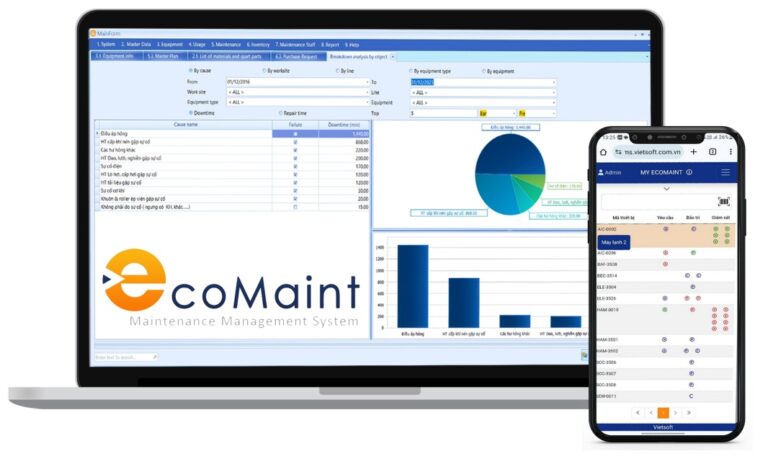
Manual asset audits are time-consuming and error-prone, especially for organizations with large or distributed asset inventories. This is where a Computerized Maintenance Management System (CMMS) like CMMS EcoMaint by Vietsoft shines. Designed to streamline asset management, CMMS EcoMaint offers features that transform how businesses perform asset audits:
- Real-Time Asset Tracking: Automatically updates asset locations, conditions, and maintenance histories.
- Barcode and QR Code Integration: Simplifies physical verification with scannable tags.
- Automated Reporting: Generates audit-ready reports with depreciation, maintenance, and compliance data.
- Maintenance Scheduling: Ensures assets are maintained proactively, reducing downtime and audit discrepancies.
- Cloud-Based Access: Allows teams to update and access asset data from any location, ideal for multi-site businesses.
Learn more about CMMS EcoMaint here. Contact us via hotline: 0986778578 or email: sales@vietsoft.com.vn.
VIII. Best Practices for Performing an Asset Audit
To maximize the effectiveness of your asset audit, follow these best practices:
- Leverage Technology: Use CMMS software to automate data collection and reporting.
- Standardize Processes: Create SOPs for asset tagging, verification, and documentation.
- Train Staff: Ensure teams understand audit procedures and tool usage.
- Schedule Regular Audits: Conduct annual or biannual audits, with more frequent checks for high-mobility assets like vehicles.
- Integrate with Accounting: Collaborate with financial teams to align asset valuations with reporting standards.
IX. Common Challenges and How to Overcome Them
Asset audits can be complex, but understanding common challenges helps you prepare:
- Challenge: Disorganized records.
- Solution: Implement a digital asset register with CMMS EcoMaint for centralized, searchable data.
- Challenge: Time-intensive physical verification.
- Solution: Use barcode/QR code scanning to speed up checks.
- Challenge: Inaccurate depreciation calculations.
- Solution: Standardize valuation methods and consult accounting experts.
- Challenge: Multi-site coordination.
- Solution: Use cloud-based CMMS for real-time data access across locations.
X. Conclusion
Performing an asset audit is not just a compliance exercise—it’s a strategic tool for optimizing operations, reducing risks, and ensuring financial accuracy. By following a structured process, leveraging tools like CMMS EcoMaint, and adhering to best practices, businesses can transform asset audits from a chore into an opportunity for growth. Whether you’re managing a small workshop or a large manufacturing plant, a well-executed asset audit empowers you to make informed decisions and stay ahead in a competitive market.