
Over more than 20 years of working alongside factories in Vietnam, Vietsoft has witnessed countless debates between maintenance departments and top management over budgets. One perennial question keeps coming up: “Does investing in maintenance really generate returns?”
The answer does not lie in vague promises, but in a powerful, transformative metric: OEE (Overall Equipment Effectiveness). OEE acts as a “financial compass”, helping businesses uncover hidden profit opportunities embedded within maintenance activities that are often overlooked in daily operations.
Let Vietsoft walk you through the relationship between OEE and maintenance cost savings in the article below.
I. What Is OEE and Why Is It the “Gold Standard” of Manufacturing?
Before diving into the relationship between OEE and maintenance cost savings, it is essential to understand what OEE truly represents.
OEE is not just a percentage. It is a comprehensive indicator that reflects the overall health of a production line, calculated based on three core pillars:
Availability
Is the machine available when it is needed? This factor is directly affected by unplanned downtime due to breakdowns (corrective maintenance) or scheduled maintenance.
Performance
Is the machine running at its optimal designed speed? Issues such as wear, instability, or improper operation reduce performance.
Quality
What percentage of output meets quality standards? Equipment issues often lead to defects and scrap.
The OEE formula is straightforward:
OEE = Availability × Performance × Quality
An improvement in OEE is not merely a better number on a report—it is a clear signal that maintenance activities are moving in the right direction, reducing waste and unlocking massive cost-saving potential.
II. The Meaning of OEE in Maintenance Operations
1. Low OEE Always Goes Hand in Hand with Maintenance Waste
· Frequent recurring failures
· Excessive emergency repair hours
· Premature replacement of spare parts due to severe damage
· Significant waiting and preparation time for repairs
2. High OEE Is the Result of an Effective Maintenance System
· Standardized preventive maintenance (PM)
· Accurate maintenance data
· Elimination of unplanned downtime
· Optimized MTBF and MTTR
3. Companies with High OEE Always Have Lower Maintenance Cost per Unit of Product
III. The Role of OEE in Achieving Effective Maintenance Cost Savings
Why is improving OEE the key to solving the equation between OEE and maintenance cost savings?
Maintenance costs are not limited to spare parts or technician wages. They are hidden in every minute of downtime, every defective product, and every emergency overtime shift.
By focusing on improving OEE, you directly influence all three core components:
· Reducing unplanned downtime
Better preventive and predictive maintenance increases Availability, reducing costly emergency interventions and production losses.
· Optimizing operational performance
Well-maintained equipment runs more smoothly and consistently, improving Performance while reducing energy and material consumption.
· Improving output quality
Accurate and stable equipment produces higher-quality products, significantly reducing scrap—a major source of waste.
In short, OEE and maintenance cost savings have a clear cause-and-effect relationship: higher OEE means better control over waste (time, materials, labor), resulting in lower operating and maintenance costs per unit of output.
IV. Three Key Ways OEE Drives Maintenance Cost Savings and Profit Growth
From Vietsoft’s implementation experience, the relationship between OEE and maintenance cost savings typically manifests in three major impact areas.
1. OEE Significantly Reduces Emergency Maintenance Costs
Emergency maintenance is the most expensive type because:
· Failures often cause cascading damage
· Downtime is prolonged
· Overtime labor is required
· Spare parts must be purchased urgently at higher prices
· In-process materials may be scrapped
By monitoring OEE, companies can clearly identify drops in Availability—indicating excessive unplanned downtime—and easily determine:
· Which equipment causes the most downtime (bad actors)
· Which failure modes occur repeatedly
· Root causes across mechanical, electrical, operational, or housekeeping factors
Even a few percentage points improvement in Availability can reduce emergency maintenance costs by 30–50%.
2. OEE Improves Maintenance Efficiency Through Standardized Data
One major reason maintenance costs escalate is decision-making based on intuition rather than data. OEE provides real-time operational data such as:
· Machine runtime hours
· Downtime reasons
· Actual operating speed vs. design speed
· Scrap generation by shift
This enables maintenance teams to transition from:
Reactive maintenance → Proactive maintenance, optimizing PM schedules and spare parts planning.
When PM is optimized:
· Emergency repairs decrease
· Maintenance schedules align with actual equipment usage
· Maintenance staff avoid burnout
· Conflicts between production and maintenance are minimized
· Spare parts costs become more controllable
3. Higher OEE Helps Avoid Capital Investment in New Equipment
This is the largest hidden saving that many companies overlook.
For example:
A factory operating at 60% OEE can increase capacity by over 25% simply by raising OEE to 75—without purchasing new machines.
Avoided investment costs may reach:
· VND 3–20 billion for a single machine
· VND 20–50 billion for a production line
· VND 100 billion for highly automated lines
In other words:
Good maintenance → High OEE → CAPEX avoidance → The most sustainable and significant savings
V. Building an OEE-Based Maintenance Strategy to Maximize Savings
To truly realize the relationship between OEE and maintenance cost savings, measurement alone is not enough. A structured action plan is essential.
1. Step 1: Map OEE Loss “Hotspots”
Analyze OEE by critical equipment, especially bottlenecks. Identify where the largest losses occur: Availability (failures), Performance (speed loss), or Quality (defects).
Key questions include:
· Which machines experience the most unplanned downtime, and why?
· What is the ratio of PM to corrective maintenance (CM)?
· Are repeated failures responsible for most downtime?
2. Step 2: Focus on “Bad Actors” and Start with Small Wins
Avoid tackling everything at once. Prioritize bad actors—machines that have the greatest impact on overall OEE. Select one or two for pilot improvement initiatives.
Achieving measurable “quick wins” provides compelling evidence to leadership of the value of OEE-driven maintenance cost savings.
3. Step 3: Shift from Corrective Maintenance (CM) to Preventive (PM) and Predictive Maintenance (PdM)
This is the core of OEE optimization. Unexpected failures cost more to repair and severely disrupt production.
Investing in PM and PdM—through condition monitoring—allows planned downtime, prepared resources, and minimized impact. A rising PM:CM ratio is a hallmark of an effective maintenance organization and stable OEE.
4. Step 4: Measure, Report, and Communicate Effectively
Turn OEE and maintenance cost data into clear, visual reports. Show management tangible results:
“By investing X million VND in maintenance improvements on Machine A, OEE increased by Y%, saving Z million VND through reduced scrap and higher output.”
This transparency transforms budget requests into profit-driven investment proposals.
VI. How Much Money Can OEE Improvement Generate?
1. How to Calculate the Value of Each 1% OEE Increase
A simple formula Vietsoft often recommends:
Value of 1% OEE = (Annual Revenue × Gross Margin) ÷ Current OEE
Example:
· Annual revenue: VND 1,000 billion
· Gross margin: 20%
· Current OEE: 70%
⇒ Value of 1% OEE = (1,000 × 20%) ÷ 70 ≈ VND 2.86 billion per 1% OEE
Just plug in your factory’s numbers!
2. Profit Example from OEE Improvement
A cold-rolled steel plant with:
· Design capacity: 50,000 tons/year
· Average selling price: VND 18 million/ton
Current state:
· OEE: 68% → Actual output: 34,000 tons
· Revenue: VND 612 billion
· Variable cost: VND 12 million/ton
· Fixed cost: VND 80 billion/year
Current profit = 612 − 408 − 80 = VND 124 billion
After improving OEE to 73% (+5%):
· Output: 36,500 tons
· Revenue: VND 657 billion
· Variable cost: VND 438 billion
· Fixed cost unchanged
New profit = 657 − 438 − 80 = VND 139 billion
→ Additional profit: VND 15 billion per year from just a 5% OEE increase
→ Value per 1% OEE ≈ VND 3 billion
VII. A Powerful Tool: CMMS – The Perfect Bridge Between OEE and Maintenance Cost Savings
How can you track OEE in real time, optimize maintenance planning, and analyze financial impact? The answer lies in a professional CMMS (Computerized Maintenance Management System).
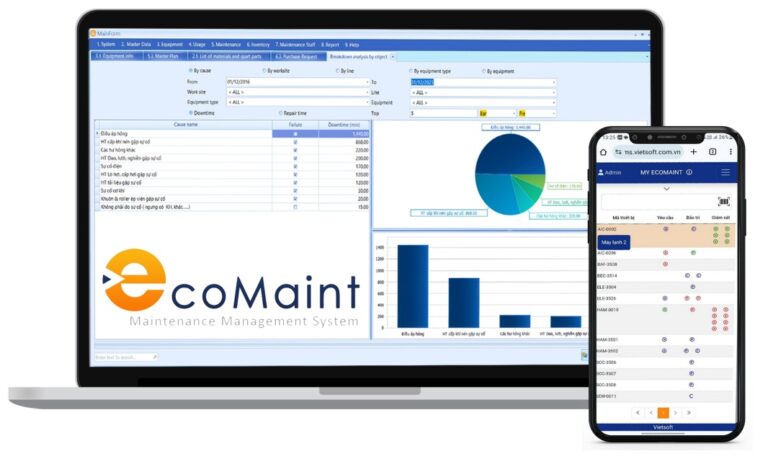
A CMMS like EcoMaint not only digitizes maintenance processes and equipment history, but also enables OEE-driven cost optimization:
· Automated OEE tracking through production line integration
· Predictive alerts based on wear trends, enabling the shift from CM to PdM
· Optimized maintenance scheduling and spare parts inventory
· Comprehensive reporting linking OEE performance with maintenance costs
Discover the CMMS EcoMaint solution here.
Contact us for consultation via hotline: 0986778578 or email: sales@vietsoft.com.vn.
VIII. Conclusion: OEE – A Common Language That Turns Maintenance into a Strategic Partner
In summary, OEE and maintenance cost savings are two sides of the same coin. OEE provides a transparent, objective measure of production effectiveness—where maintenance plays a decisive role.
By focusing on OEE improvement through proactive maintenance strategies, managers not only reduce direct repair costs but also unlock massive savings from higher productivity, reduced waste, and deferred capital investment.
Stop viewing maintenance as a cost burden.
Use OEE as a common language with leadership to prove that every smart investment in maintenance delivers clear and measurable returns.