For more than a decade, the Industry 4.0 revolution has cast a “gray shade” of automation and the Internet of Things across manufacturing plants everywhere. Everything seemed to revolve around data, sensors, and machines capable of running nonstop. Yet the biggest question remained unanswered: Where do people stand in that digital picture?
That is why Industry 5.0 emerged—not to deny the achievements of its predecessor, but to complement them, elevate them, and bring a new balance. Industry 5.0 shifts the focus from “technology taking control” to “technology serving people.” In that context, the role of CMMS maintenance management software in Industry 5.0 is not merely a tool for digitizing processes, but a reliability operations platform—a bridge for realizing a smarter, more sustainable, and more human-centered manufacturing ecosystem.
I. Properly Understanding Industry 5.0 in Maintenance
Many people mistakenly assume that Industry 5.0 is simply an upgraded version of 4.0. In reality, it represents a philosophical shift. If Industry 4.0 asked, “How can we fully automate processes and eliminate human error?” then Industry 5.0 asks, “How can technology help people work smarter, safer, and more creatively?” In Vietnam, where the manufacturing sector is growing strongly but facing rising energy costs and increasing environmental requirements, adopting Industry 5.0 helps businesses compete sustainably.
In maintenance, this has especially important implications. We are witnessing a transition from a “rigid” maintenance strategy to an “adaptive” one, based on three main pillars:
- Human-centered approach: Technicians are no longer passive machine operators. They are empowered professionals who use data and smart tools to make the best possible decisions. Systems are designed to serve them, not the other way around.
- Sustainability: Encouraging “green maintenance.” Instead of mass replacement of new parts, the goal is to repair, recycle, and reuse, maximizing equipment life cycles and minimizing industrial waste.
- Resilience: Building a manufacturing system that can adapt to any disruption, from supply chain breakdowns to unexpected failures. This resilience comes from combining the analytical power of machines with the flexible problem-solving ability of people.
These three pillars have completely reshaped the role of CMMS maintenance management software in Industry 5.0, requiring CMMS solutions to be intelligent, flexible, and capable of going beyond work order management to true reliability operations.
II. Typical Maintenance Pain Points as Factories Enter the 5.0 Era
To clearly see the role of CMMS, let us look directly at the maintenance issues commonly found in factories—especially in the Vietnamese manufacturing environment, with multiple shifts, diverse product lines, and rapid expansion:
- Reactive maintenance accounts for a high proportion
Failures happen unexpectedly → priority is put on “firefighting” → preventive maintenance gets postponed → the downtime cycle repeats. - Scattered data, no traceability of the “why”
Failure history is stored in Excel files, Zalo chats, notebooks, or only “in the supervisor’s head.” When root cause analysis (RCA) is needed, the maintenance team lacks evidence. - Spare parts are unavailable when needed—and overstocked when not needed
No BOM/usage standards, no standardized material codes, no control of stock in–out–on hand by work order → both shortages and excess inventory occur, often leading to urgent purchases at high prices. - Safety and compliance are not embedded into processes
Permit to Work (PTW), Lock in – Tag Out (LOTO), safety checklists, inspections, etc. can easily be overlooked when handled manually under schedule pressure. - Energy consumption gradually increases because equipment “silently deteriorates”
Misalignment, imbalance, increased friction, clogged filters, improper lubrication, etc. can cause kWh per unit of product to rise without anyone noticing early enough. - Factories are highly vulnerable to disruptions
If a bottleneck asset fails, the entire line stops. Without risk management based on criticality, businesses struggle to be truly resilient.
This is precisely the challenge every company must face on its digital transformation journey. CMMS maintenance management software in Industry 5.0 addresses these issues by shifting from reactive maintenance to predictive and prescriptive maintenance, while still keeping people at the center of decision-making.
III. From Automation to Smart Collaboration: “Humans in the Loop”
Looking back, the dream of Industry 4.0 was “lights-out manufacturing.” But reality has shown that a fully automated system is highly vulnerable. It works well only in pre-programmed scenarios and becomes helpless when faced with unusual situations.
Industry 5.0 introduces the concept of Human-in-the-Loop. This is where the role of CMMS maintenance management software in Industry 5.0 becomes most evident. It is no longer a command-and-control system, but a powerful assistant with Reliability Intelligence capabilities:
- Data Collection and Analysis: Thousands of IoT sensors on machines continuously send data to the CMMS (temperature, vibration, current, etc.). The software uses AI and Machine Learning to detect abnormal signals—anomalies that are difficult to notice with the naked eye. For example, a motor may show slightly unusual heat buildup over three consecutive days.
- Alerts and Recommendations: Instead of automatically shutting down a machine or replacing components, the CMMS analyzes historical data, predicts the likelihood of failure, and creates a work order with initial diagnostic recommendations. A key difference is that the system can also automatically check inventory status to indicate whether the work order is truly “ready” for execution.
- Final Decisions Made by Humans: This is when the role of managers or experienced technicians truly comes into play. They review the alert, compare it with operating history and current production conditions, and decide the best timing for repair. For example: “Yes, the bearing is showing problems, but this shift is processing an urgent order. We will schedule the replacement at the start of the next shift, when the line is temporarily stopped for cleaning.”
- Execution and Knowledge Capture: The assigned technician uses the CMMS on a mobile device to access repair instructions. Once the task is completed, they record the procedure, materials used, and any special notes in the system, turning individual experience into organizational knowledge.
It is clear that CMMS has become the “brain” that connects information and the “memory” that stores knowledge, while people remain the “heart” that guides every decision. That is the core spirit of Industry 5.0.
IV. What Is CMMS Maintenance Management Software in Industry 5.0, and How Is It Different from Traditional CMMS Software?
CMMS (Computerized Maintenance Management System) is a system that helps plan, execute, record, and analyze all maintenance activities and asset/equipment management.
However, in the context of Industry 5.0, CMMS software is no longer limited to:
- Creating repair work orders
- Storing operating and maintenance histories
- Printing end-of-month reports
Instead, it must become the data backbone for three Industry 5.0 goals:
- Supporting human decision-making (assisted decision-making, human-in-the-loop)
- Reducing resource waste and emissions (green, circular maintenance)
- Increasing resilience through risk management and forecasting
Therefore, a “5.0-standard” CMMS must do two things at the same time:
- Be intelligent: Connect data (IoT/SCADA/MES/ERP), provide early warnings, suggest actions, and analyze KPIs.
- Be user-friendly: Easy-to-use interface, mobile-first design, fast field operations, standardized safety checklists, and knowledge retention so new staff can perform effectively.
If a CMMS is only “smart” but hard to use → technicians become reluctant to enter data → data becomes poor quality → AI/analytics lose meaning.
If a CMMS is only “easy to use” but lacks analytics → the organization still ends up chasing breakdowns.
V. CMMS Software as the “Chief Architect” of a Green and Sustainable Maintenance Strategy
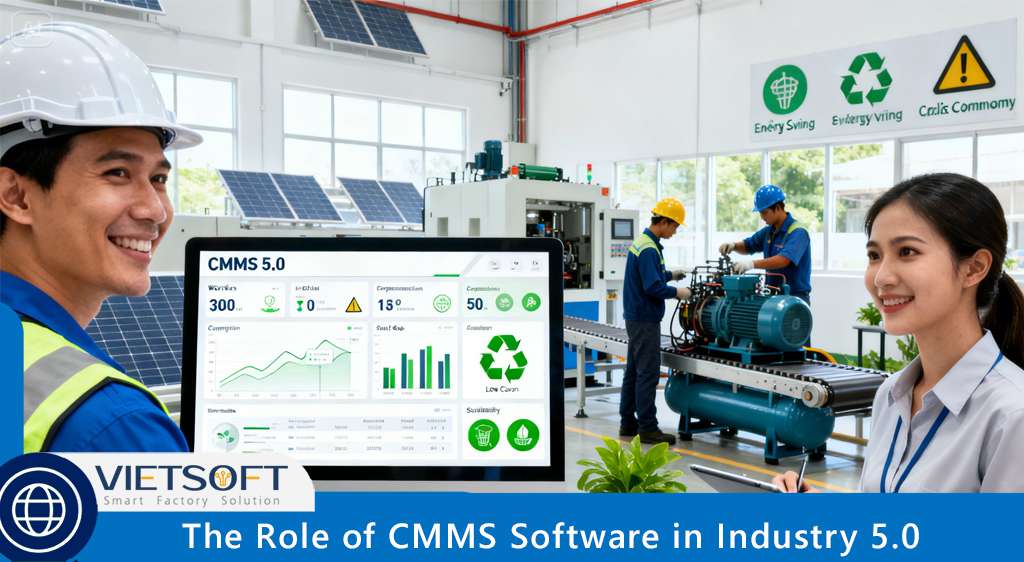
One of the most important goals of Industry 5.0 is sustainable development. Few people realize that the maintenance team can make a major contribution to this goal. The role of CMMS maintenance management software in Industry 5.0 is to make green maintenance a reality.
- Promoting the circular economy: Detect abnormal replacements early → prioritize repair over replacement → reduce component and spare-part waste.
- Optimizing energy use: Monitor performance and downtime → identify equipment consuming excess energy (for example, an air compressor using 15% more electricity) → reduce carbon emissions.
- Precision maintenance: Move from fixed schedules to predictive/condition-based maintenance (data + AI) → save lubricants, spare parts, and labor; Work Order Readiness features also help avoid waste caused by waiting for materials.
VI. EcoMaint – A Reliability Intelligence Platform for Maintenance and Manufacturing in the Industry 5.0 Era
So how can Vietnamese businesses keep up with this wave and realize these values? The answer lies in choosing a CMMS solution that is not only technologically strong, but also deeply aligned with the philosophy of putting people at the center and truly capable of reliability operations.
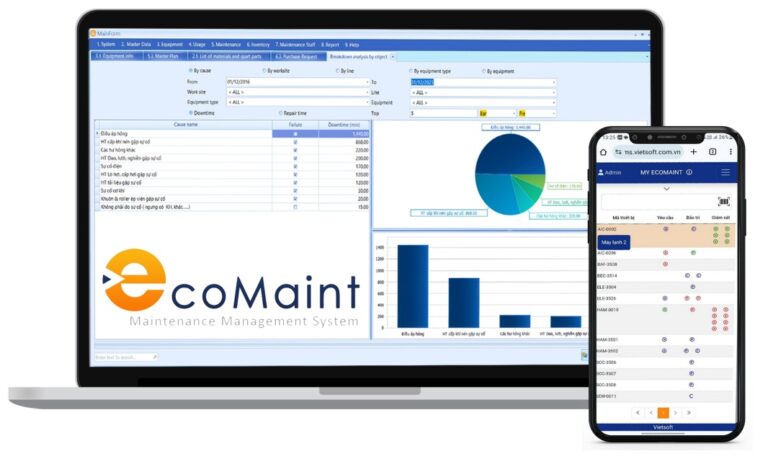
That is why EcoMaint CMMS was created, developed by Nam Viet Software Co., Ltd. (Vietsoft). EcoMaint CMMS maintenance management software, developed by Vietsoft, is not just an ordinary maintenance management software package, but a platform that enables equipment reliability operations. This solution helps businesses shift from breakdown repair to proactive, data-driven, AI-based predictive maintenance.
Key highlights:
- Vietnamese and English interfaces, suitable for both domestic and international businesses.
- Transforms data into easy-to-understand information, helping answer critical questions quickly:
- Where are today’s bottlenecks? Which work orders are ready to execute immediately, and which are waiting for spare parts?
- Which incidents should be handled first?
- Which assets fail repeatedly or incur unusually high costs?
- What is the root cause?
- Which spare parts are being replaced too early?
- Who needs to do what next?
Every issue is handled in a closed loop: detect → assess → assign responsibility → act → verify results.
EcoMaint CMMS helps maintenance teams not only manage tasks but also operate equipment reliability—an important step for businesses to keep pace with sustainable Industry 5.0.
Discover the EcoMaint CMMS maintenance management software solution here: https://ai-smart-factory.com/cmms-ecomaint/
Or contact us for consultation via hotline: 0986778578 or email: sales@vietsoft.com.vn