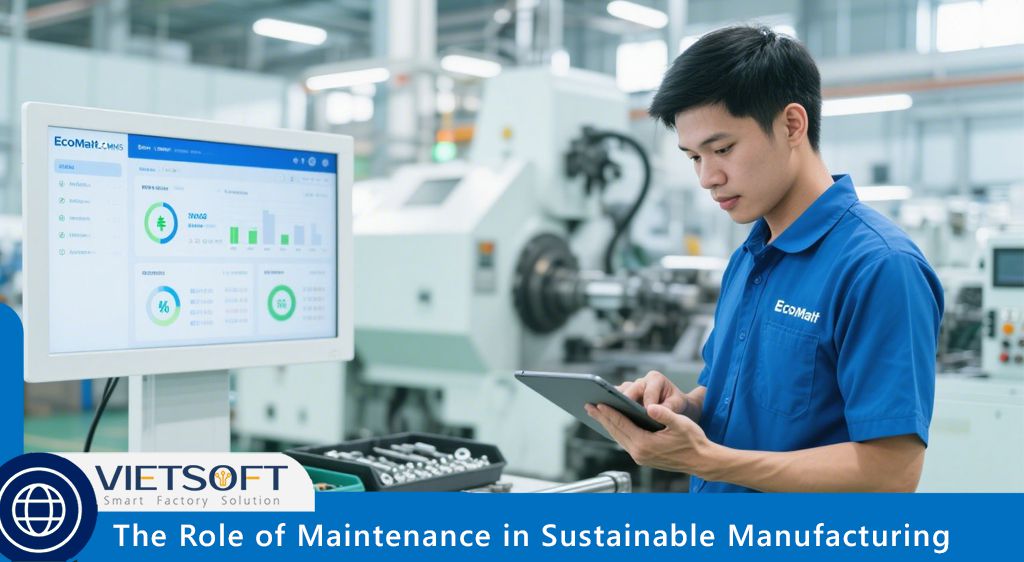
Sustainable manufacturing is a critical approach for modern industries aiming to balance economic growth, environmental responsibility, and social well-being. At the heart of this paradigm lies the role of maintenance, a strategic function that ensures operational efficiency while supporting sustainability goals. This article explores how maintenance practices, particularly when enhanced by advanced tools like CMMS EcoMaint from Vietsoft, contribute to sustainable manufacturing. By delving into the evolution of maintenance, its alignment with the triple bottom line (People, Planet, Profit), and practical applications, we aim to provide a comprehensive guide for maintenance professionals and industry leaders in Vietnam and beyond.
I. What Is Sustainable Manufacturing?
Sustainable manufacturing refers to the creation of products through processes that minimize environmental impact, conserve resources, ensure worker safety, and maintain economic viability. It is guided by the triple bottom line framework:
- Planet: Reducing environmental impact through resource efficiency, waste minimization, and lifecycle thinking.
- Profit: Enhancing economic performance by reducing costs, improving efficiency, and ensuring compliance.
- People: Promoting worker safety, community well-being, and ethical practices.
The role of maintenance in this context is pivotal, as it directly influences all three pillars by ensuring equipment reliability, reducing resource waste, and fostering safer workplaces.
II. The Evolution of Maintenance in Manufacturing
To understand the role of maintenance in sustainable manufacturing, it’s essential to trace its evolution:
1. First Generation: Reactive Maintenance
Before the 1950s, maintenance was largely reactive, addressing equipment failures only after they occurred. This “run-to-failure” approach led to significant downtime, high repair costs, and environmental waste due to unplanned part replacements and energy inefficiencies.
2. Second Generation: Preventive Maintenance
Post-World War II, industrialization spurred the adoption of preventive maintenance. Scheduled inspections and part replacements aimed to extend equipment life, reducing unexpected breakdowns. While this approach improved reliability, it often led to over-maintenance, wasting resources.
3. Third Generation: Proactive and Predictive Maintenance
From the 1970s, advancements in diagnostic tools and management philosophies like Lean Manufacturing and Total Quality Management transformed maintenance. The role of maintenance shifted from merely fixing breakdowns to proactively enhancing equipment performance. Techniques like predictive maintenance (using tools like vibration analysis) and condition-based maintenance optimized resource use and minimized waste.
4. Fourth Generation: Sustainable Maintenance
Today, maintenance aligns with sustainable manufacturing by integrating economic, environmental, and social considerations. Sustainable maintenance focuses on:
- Proactivity: Anticipating issues to prevent failures.
- Lifecycle Thinking: Considering equipment from design to disposal.
- Stakeholder Integration: Balancing the needs of internal (e.g., operators) and external (e.g., suppliers) stakeholders.
This evolution underscores how the role of maintenance has expanded to become a cornerstone of sustainable manufacturing.
III. Why Maintenance Matters for Sustainable Manufacturing
The role of maintenance in sustainable manufacturing is multifaceted, impacting all aspects of the triple bottom line. Below, we explore its contributions in detail.
1. Environmental Benefits of Maintenance
Maintenance practices directly contribute to environmental sustainability by:
- Reducing Energy Consumption: Well-maintained equipment operates at peak efficiency, consuming less energy. For example, regular lubrication reduces friction, and timely repairs prevent energy losses from leaks or misalignments. Studies suggest proactive maintenance can reduce energy consumption by 5–15%.
- Minimizing Waste: Preventive and predictive maintenance reduce scrap from defective products and extend component life, decreasing the need for replacements. For instance, oil diagnostics can optimize lubricant use, reducing waste by up to 20%.
- Preventing Environmental Incidents: Proactive maintenance mitigates risks of spills or emissions from equipment failures, protecting local ecosystems.
- Supporting Circular Economy: Maintenance enables component reuse and refurbishment, reducing reliance on virgin materials. For example, refurbishing a pump instead of replacing it saves both resources and costs.
2. Economic Advantages of Maintenance
The role of maintenance extends to economic sustainability by:
- Lowering Operational Costs: Proactive maintenance reduces unplanned downtime, emergency repair costs, and overtime labor. A CMMS like EcoMaint can optimize maintenance schedules, minimizing unnecessary tasks.
- Extending Asset Lifespan: Regular care prevents premature equipment failure, deferring capital expenditures. For instance, condition-based maintenance can extend equipment life by 10–20%.
- Enhancing Compliance: Maintenance ensures adherence to environmental regulations, avoiding fines. A CMMS tracks compliance-related activities, providing audit trails.
- Boosting Productivity: Reliable equipment minimizes production disruptions, improving throughput and profitability.
3. Social Impacts of Maintenance
Maintenance also enhances social sustainability by:
- Improving Worker Safety: Regular inspections and repairs reduce equipment-related hazards, creating safer workplaces. For example, monitoring critical systems with sensors can prevent accidents.
- Enhancing Employee Well-Being: A reliable maintenance strategy reduces stress from unexpected breakdowns, fostering a positive work environment.
- Supporting Community Relations: By minimizing environmental incidents (e.g., noise, pollution), maintenance contributes to positive community perceptions.
IV. Key Maintenance Strategies for Sustainability
To fully realize the role of maintenance in sustainable manufacturing, companies must adopt advanced strategies:
1. Preventive Maintenance (PM)
Preventive maintenance involves scheduled tasks like inspections, lubrication, and part replacements. It supports sustainability by:
- Reducing energy waste through optimized equipment performance.
- Preventing catastrophic failures that lead to material waste and environmental harm.
- Extending equipment life, reducing the need for new machinery.
2. Predictive Maintenance (PdM)
Predictive maintenance uses real-time data (e.g., vibration, temperature) to predict failures. Its benefits include:
- Resource Efficiency: Maintenance is performed only when needed, reducing unnecessary part replacements.
- Energy Savings: Early detection of inefficiencies (e.g., leaks) prevents energy loss.
- Minimized Downtime: Targeted interventions ensure continuous production.
3. Condition-Based Maintenance (CBM)
CBM triggers maintenance based on equipment condition, optimizing resource use and reducing over-maintenance. For example, replacing a bearing only when wear is detected saves materials and labor.
4. Reliability-Centered Maintenance (RCM)
RCM prioritizes maintenance for critical assets, balancing reliability with environmental and safety considerations. It uses techniques like Failure Mode and Effects Analysis (FMEA) to identify and mitigate risks.
5. E-Maintenance
E-maintenance leverages digital tools like IoT sensors and cloud-based systems to enable real-time monitoring and predictive analytics. This approach supports sustainability by:
- Reducing unnecessary maintenance tasks.
- Providing data for lifecycle management.
- Enhancing collaboration between departments and external stakeholders.
V. The Role of CMMS EcoMaint in Sustainable Maintenance
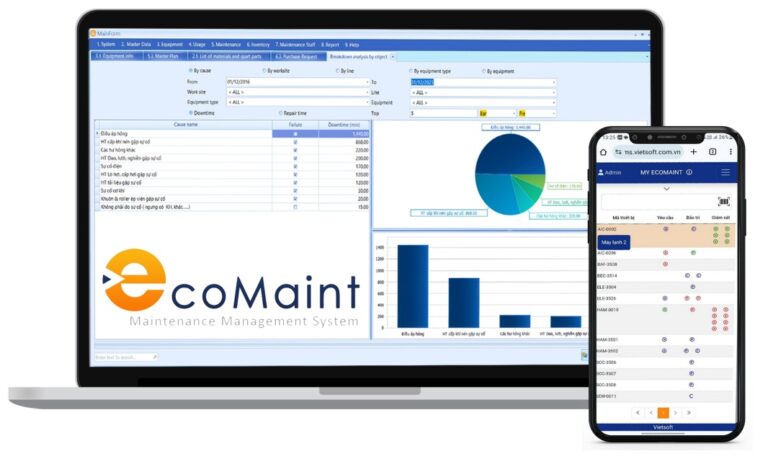
A Computerized Maintenance Management System (CMMS) like EcoMaint, developed by Vietsoft, is a game-changer for sustainable maintenance. EcoMaint streamlines maintenance operations, aligning them with sustainability goals. Here’s how it enhances the role of maintenance:
1. Optimizing Maintenance Schedules
EcoMaint uses data-driven insights to schedule maintenance based on actual equipment needs, reducing over-maintenance and associated waste.
2. Energy and Resource Management
By integrating with IoT sensors, EcoMaint tracks energy consumption and identifies inefficiencies. For instance, it can detect a motor consuming excess energy due to misalignment, prompting timely repairs.
3. Waste Reduction and Compliance
EcoMaint tracks waste streams (e.g., used oil) and ensures compliant disposal. It also maintains records for environmental audits, reducing the risk of fines.
4. Predictive Analytics
EcoMaint’s predictive capabilities analyze historical data to forecast failures, enabling proactive interventions. This minimizes downtime and resource waste, supporting both economic and environmental goals.
5. Inventory Management
EcoMaint optimizes spare parts inventory, preventing overstocking and obsolescence. This reduces material waste and ensures critical spares are available when needed.
6. Mobile Accessibility
With mobile access, technicians can log issues and access maintenance plans on the go, reducing response times and improving efficiency.
To learn more about how EcoMaint can transform your maintenance strategy, visit Vietsoft’s EcoMaint product page.
VI. Measuring Success: Key Performance Indicators (KPIs)
To evaluate the role of maintenance in sustainable manufacturing, companies should track KPIs such as:
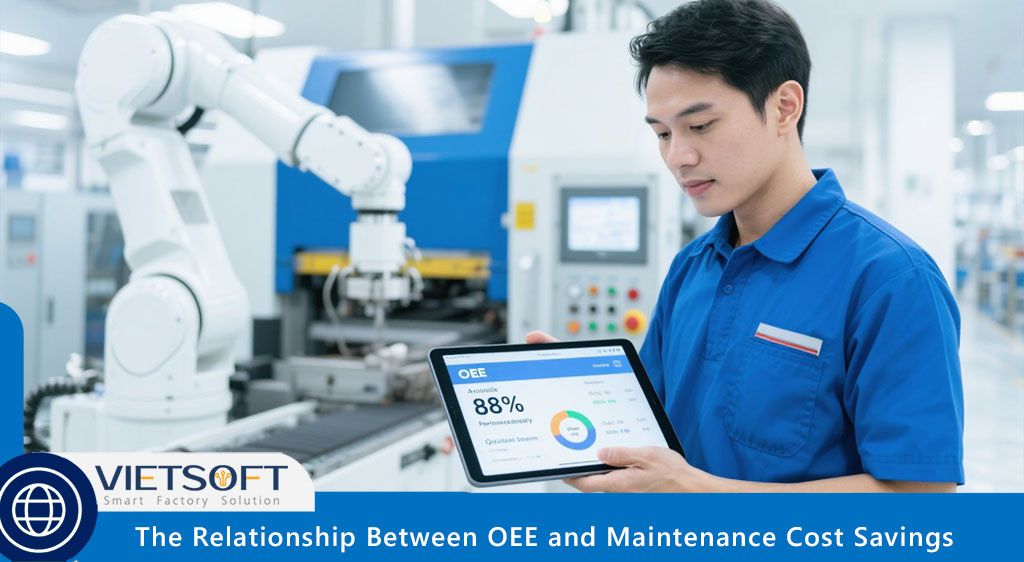
- Overall Equipment Effectiveness (OEE): Measures availability, performance, and quality. Higher OEE indicates efficient, sustainable operations.
- Technical Availability (TA): Tracks equipment uptime, reflecting maintenance effectiveness.
- Energy Consumption: Monitors reductions in energy use due to maintenance improvements.
- Waste Generation: Measures reductions in material and waste output.
- Mean Time Between Failures (MTBF): Indicates equipment reliability improvements.
- Safety Incidents: Tracks reductions in workplace accidents.
VII. Challenges in Implementing Sustainable Maintenance
Despite its benefits, implementing sustainable maintenance faces challenges:
- Initial Costs: Investing in CMMS software and sensors requires upfront capital. However, ROI is typically achieved within 1–2 years through cost savings.
- Cultural Resistance: Shifting from reactive to proactive maintenance requires a mindset change. Training and leadership support are critical.
- Data Integration: Linking CMMS with existing systems (e.g., ERP) can be complex but is essential for maximizing benefits.
- Skill Gaps: Technicians may need training to use advanced tools like EcoMaint effectively.
VIII. Steps for Successful Implementation
To overcome these challenges and maximize the role of maintenance in sustainable manufacturing, follow these steps:
· Secure Leadership Buy-In: Engage senior management to champion sustainability goals.
· Adopt a Phased Approach: Start with a pilot project to test CMMS implementation.
· Provide Comprehensive Training: Train staff on CMMS use and sustainability principles.
· Choose the Right CMMS: Select a system like EcoMaint that offers scalability, mobile access, and predictive analytics.
· Define Clear KPIs: Link maintenance metrics to sustainability outcomes.
· Foster a Data-Driven Culture: Encourage continuous improvement through CMMS data analysis.
IX. The Future of Maintenance in Sustainable Manufacturing
Emerging technologies are shaping the future of the role of maintenance:
- Artificial Intelligence (AI): AI-powered analytics enhance failure predictions, optimizing maintenance schedules.
- Digital Twins: Virtual models of equipment enable real-time simulation and optimization.
- Augmented Reality (AR): AR assists technicians with real-time guidance, reducing errors and downtime.
- Circular Economy Integration: Maintenance data supports product design for durability and recyclability.
Additionally, increasing regulatory pressure and consumer demand for sustainability will make proactive maintenance indispensable. Tools like EcoMaint will be critical in meeting these expectations while maintaining competitiveness.
X. Conclusion: Building a Sustainable Future
The role of maintenance in sustainable manufacturing is transformative, bridging environmental responsibility, economic efficiency, and social well-being. By adopting proactive strategies and leveraging tools like CMMS EcoMaint, manufacturers can reduce waste, optimize resources, and enhance safety. Vietsoft’s EcoMaint empowers businesses to achieve these goals with its robust features, from predictive analytics to mobile accessibility. As industries in Vietnam and globally strive for sustainability, maintenance emerges as a strategic enabler, paving the way for greener, smarter, and faster operations.
For a deeper dive into how EcoMaint can revolutionize your maintenance practices, Learn more about CMMS EcoMaint here.
Contact us for consultation via hotline: 0986778578 or email: sales@vietsoft.com.vn.