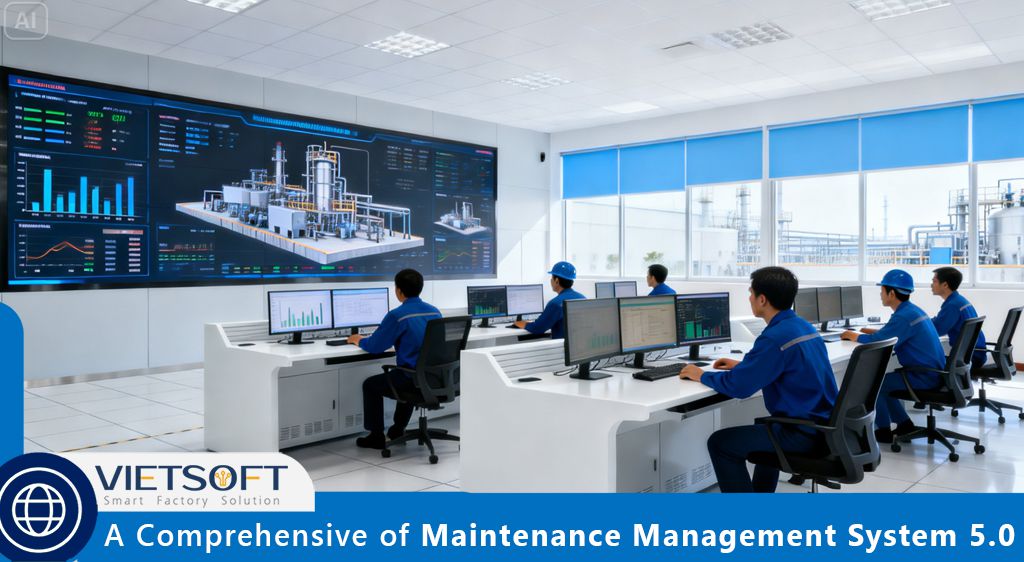
A comprehensive maintenance management system 5.0 represents this fundamental shift—moving from data collection to intelligent action, from automation to human-machine collaboration, and from reactive fixes to sustainable reliability.
I. The Evolution of Maintenance Thinking
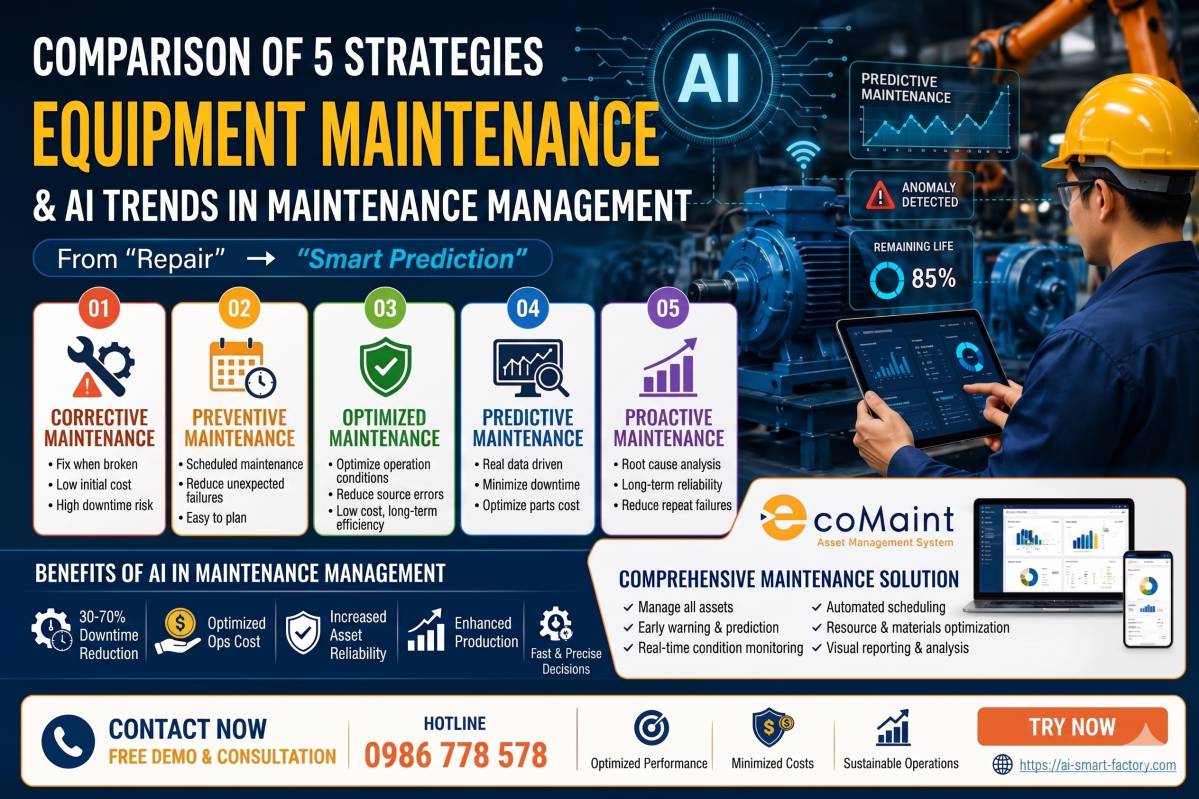
If you’ve worked in manufacturing for any length of time, you’ve witnessed the transformation of maintenance practices. We moved from reactive “fix-it-when-it-breaks” approaches to preventive maintenance schedules. Handwritten logbooks became Excel spreadsheets, and eventually, Industry 4.0 brought us IoT sensors, real-time data, and sophisticated dashboards.
But here’s the problem many plant managers now face: more data doesn’t automatically mean better decisions. Teams are drowning in alerts, overwhelmed by dashboards, and still struggling with fundamental questions like “What should we fix first?” or “Why does this same problem keep happening?”
This is why the conversation has shifted to Industry 5.0. Smart manufacturers are no longer asking “How do we collect more data?” but rather “How do we make our maintenance systems truly intelligent?”
II. What is a Comprehensive Maintenance Management System 5.0?
A comprehensive maintenance management system 5.0 is an integrated operational platform that unifies all asset-related data, human expertise, and business processes into a single intelligence layer. Unlike traditional CMMS platforms that focus primarily on work order tracking, this new generation serves as a reliability operating center where data transforms into actionable insights.
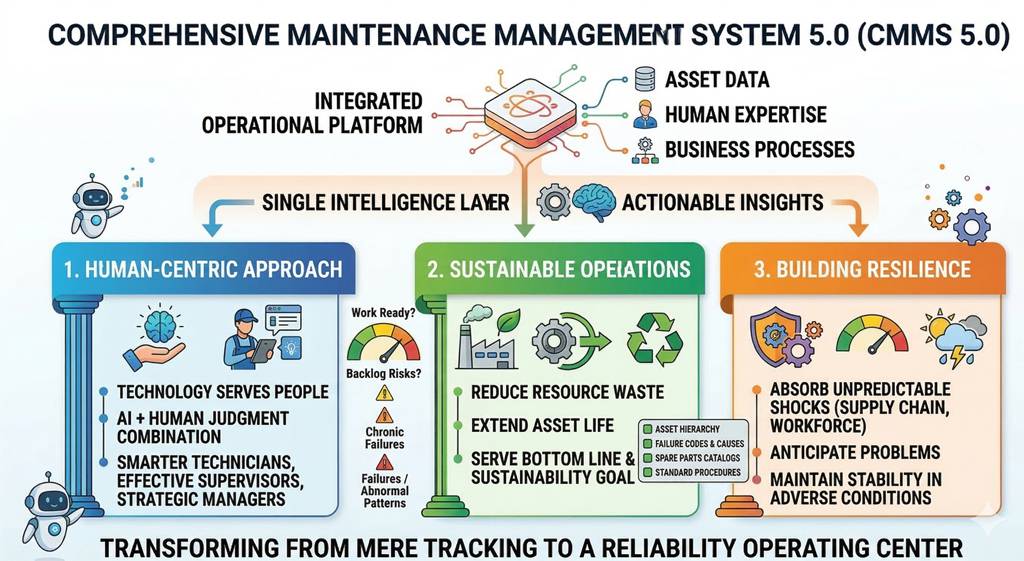
The philosophy rests on three pillars that distinguish it from everything that came before:
1. Human-Centric Approach
Technology exists to serve people, not replace them. In the 5.0 mindset, the most powerful combination is human judgment enhanced by machine intelligence. The goal isn’t to remove people from decisions but to give them better tools—making technicians smarter, supervisors more effective, and managers more strategic.
2. Sustainable Operations
Sustainability goes beyond environmental compliance. Every time you replace a bearing prematurely, you’re wasting resources, generating waste, and shortening asset life. A comprehensive maintenance management system 5.0 helps identify inefficiencies and make choices that serve both your bottom line and broader sustainability goals.
3. Building Resilience
Modern manufacturing faces unpredictable challenges: supply chain disruptions, workforce changes, sudden demand shifts. Resilience means building systems that absorb shocks and continue functioning. This isn’t just about responding to problems—it’s anticipating them and maintaining stability when conditions are far from ideal.
III. The Journey: From 4.0 to 5.0
Industry 4.0 focused on connectivity and automation. Sensors monitored equipment, data streamed in real-time, and dashboards displayed every conceivable metric. But organizations faced a paradox: data rich, insight poor.
Industry 4.0 asked: “What can we automate?”
Industry 5.0 asks: “How can we augment human capabilities?”
A comprehensive maintenance management system 5.0 answers this question by keeping humans in the decision loop while providing intelligent support. Sensors detect anomalies, AI identifies patterns, but experienced professionals decide when to intervene, how to prioritize, and what actions make sense for the business
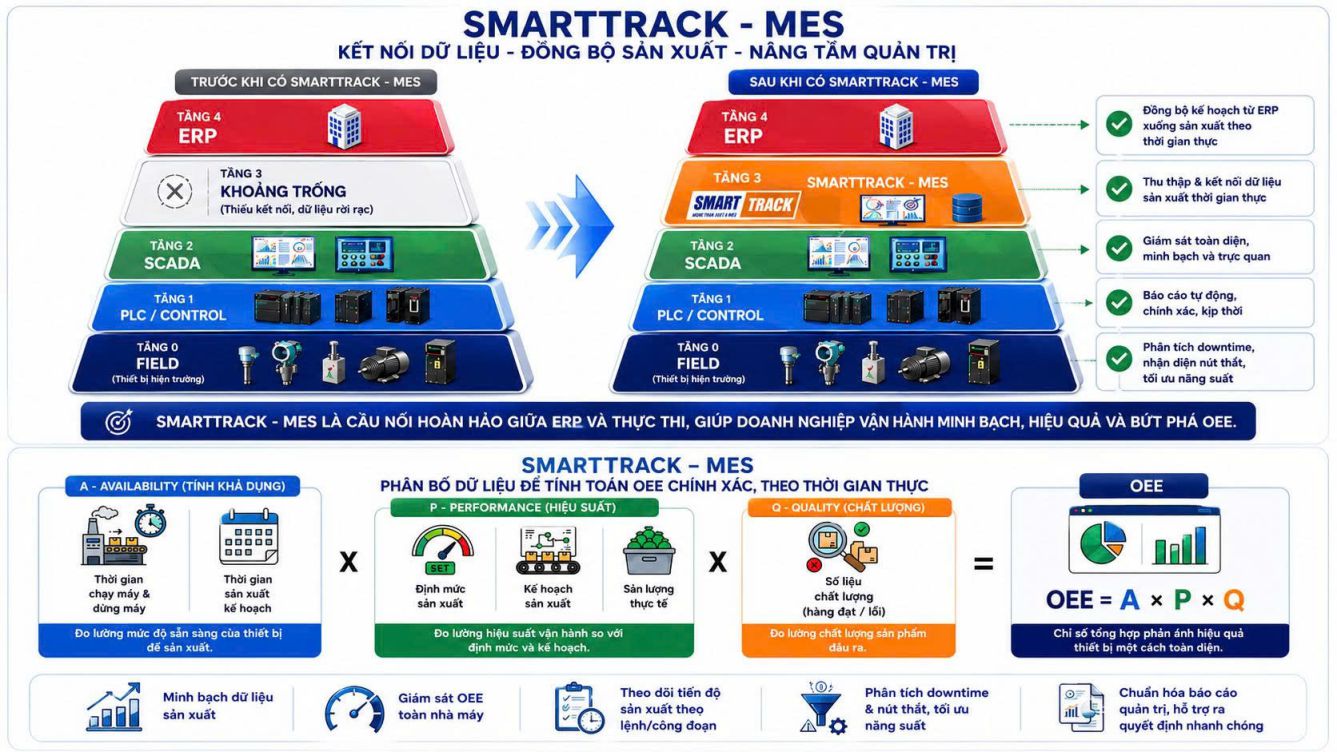
IV. The Five-Layer Architecture
Understanding how a comprehensive maintenance management system 5.0 works requires looking at its layered architecture:
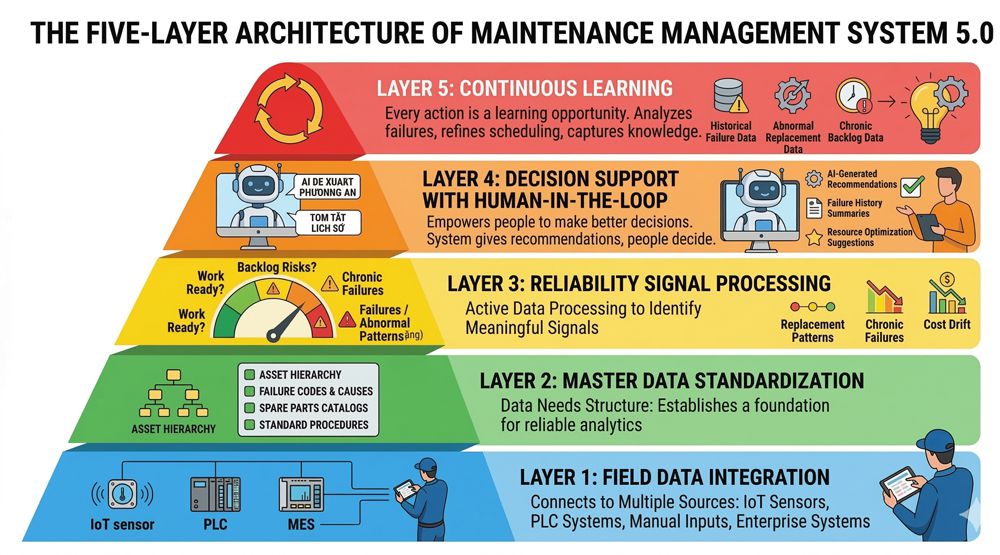
1. Layer 1: Field Data Integration
The foundation connects to multiple sources: IoT sensors, PLC systems, manual technician inputs, and enterprise systems. Raw data becomes meaningful when connected to specific assets and operating contexts.
2. Layer 2: Master Data Standardization
Data needs structure. This layer establishes asset hierarchies, failure codes, spare parts catalogs, and standard procedures. Without this foundation, even sophisticated analytics produce unreliable results.
3. Layer 3: Reliability Signal Processing
This is where differentiation begins. The system actively processes data to identify meaningful signals: work order readiness, backlog risks, abnormal replacement patterns, chronic failures, and cost drift. These signals transform raw data into actionable intelligence.
4. Layer 4: Decision Support with Human-in-the-Loop
The system doesn’t make decisions—it empowers people to make better ones through AI-generated recommendations, risk-prioritized work queues, and resource optimization suggestions.
5. Layer 5: Continuous Learning
Every maintenance action becomes a learning opportunity. Failure analysis updates reliability data, actual repair times refine scheduling estimates, and successful interventions become searchable knowledge assets.
V. Real-World Impact: A Practical Scenario
Let’s see how a comprehensive maintenance management system 5.0 works in practice:
A critical cooling water pump shows increasing vibration. Sensors detect the trend and feed data to the maintenance platform. The system compares the pattern against historical failure modes, identifies it as bearing degradation, checks parts inventory, confirms the correct bearing is available, and reserves it.
The system then checks the production schedule, identifies a planned changeover in six hours, and creates a draft work order timed for that window. The maintenance supervisor’s dashboard shows a new high-priority item with recommended timing and estimated repair duration.
The supervisor reviews, approves with one click, and the technician receives the assignment on a mobile device complete with bearing specifications, previous repair history, and step-by-step procedures. During the changeover, the bearing is replaced. No unplanned downtime occurs.
This is the difference between reacting to failures and proactively managing reliability.
VI. What Makes It Truly Comprehensive?
1. Asset Lifecycle Integration
The system views assets dynamically throughout their entire lifecycle—from acquisition through operation to replacement—ensuring decisions consider long-term implications.
2. Spare Parts Intelligence
Real-time parts availability checking, automatic reservation for scheduled work, and criticality-based stocking recommendations transform inventory from a separate function into integrated maintenance execution.
3. Workforce Capability Management
Skill matrices, training need identification, and knowledge capture help develop and deploy your most valuable asset—your people.
4. Financial Visibility
Integrated cost tracking transforms maintenance from a cost center into strategically managed investment.
VII. Key Capabilities to Look For
- Real-Time Operational Intelligence: Live equipment status, active work orders, and emerging reliability issues as they develop.
- Early Anomaly Detection: Statistical process control, pattern recognition, and replacement frequency monitoring identify problems early.
- Intelligent Work Prioritization: Risk-based prioritization considering safety, production impact, and cost helps focus on what matters most.
- Seamless Mobile Execution: Technicians access information, document work, and collaborate from the field without returning to the shop.
- Closed-Loop Learning: Every maintenance event makes your organization smarter through root cause analysis and procedure refinement.
VIII. Strategic Value for Your Organization
- Enhanced Equipment Reliability: Organizations typically achieve 15-30% reduction in unplanned downtime and 20-40% extension in mean time between failures.
- Optimized Maintenance Spending: Better intelligence means spending dollars where they create most value—typically 10-25% cost reduction with 20-30% less overtime.
- Improved Workforce Productivity: Technicians spend less time searching for information and more time applying skills—20-35% reduction in administrative time is common.
- Better Capital Planning: Accurate condition data and total cost of ownership analysis support smarter investment decisions.
- Enhanced Safety Performance: Early identification of safety-critical issues and better preventive maintenance compliance protect your people.
IX. Implementation: A Practical Approach
- Start with Clear Objectives: Define what you want to achieve—reduced downtime, lower costs, extended asset life—before selecting technology.
- Build Your Data Foundation: Complete asset registers, standardized failure coding, and documented spare parts pay enormous dividends.
- Phase by Value: Implement core work order management first, then preventive scheduling, parts integration, mobile deployment, and finally advanced analytics.
- Invest in Change Management: Training, communication, and early involvement of technicians determine success more than technology alone.
- How Modern CMMS Platforms Enable This Vision
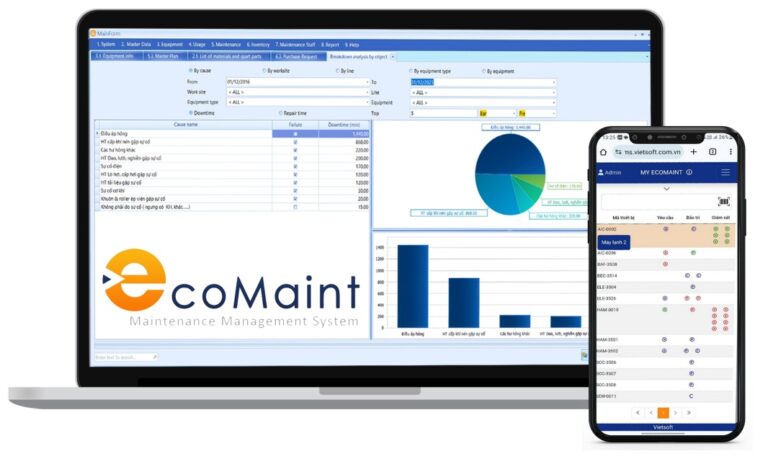
- Platforms like CMMS EcoMaint embody comprehensive maintenance management system 5.0 thinking through:
- Integration Capabilities: Connecting to existing sensors, PLCs, and enterprise systems without replacing current infrastructure.
- Intelligence Features: Actively identifying patterns and opportunities rather than simply reporting data.
- Human-Centric Design: Designed for the people who actually use it—technicians on mobile devices, supervisors planning work, managers analyzing trends.
- Continuous Evolution: Commitment to advancing as technology and best practices evolve.
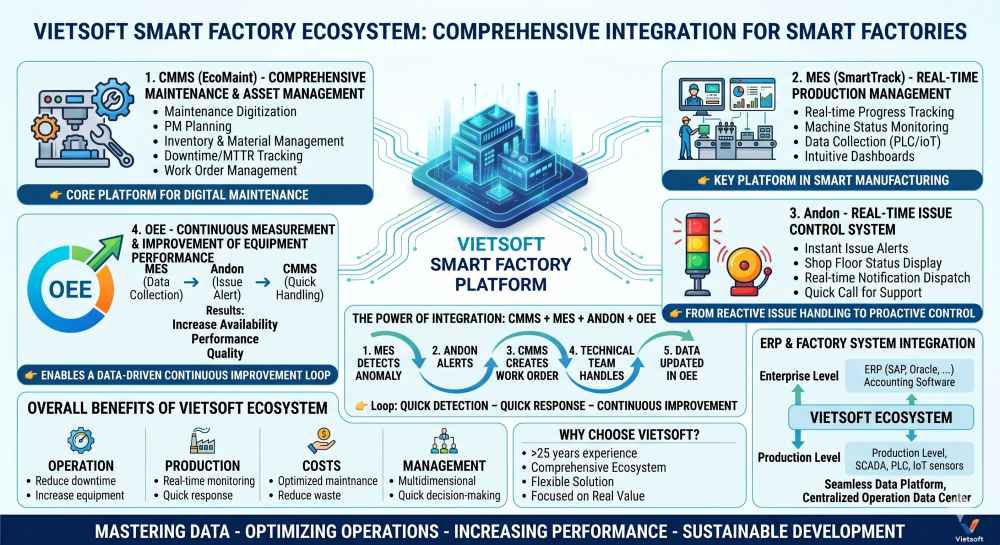
At Vietsoft, we’ve developed CMMS EcoMaint specifically to address this vision. Our 2026 release represents our most complete expression of intelligent, human-centric maintenance.
X. The Future of Maintenance
- Deeper AI Integration: Systems will engage in natural language conversations about equipment issues and generate detailed root cause hypotheses.
- Predictive Prescriptions: Beyond predicting failures, systems will prescribe specific interventions with confidence levels.
- Digital Twin Integration: Virtual representations of physical assets will simulate equipment behavior and test strategies virtually.
- Sustainability Optimization: Environmental impact will become a primary optimization criterion alongside cost and reliability.
- Autonomous Collaboration: Equipment will communicate directly with maintenance systems, scheduling its own maintenance and updating digital twins.
Is Your Organization Ready?
Ask yourself:
- Does leadership view maintenance as strategic or simply operational?
- Do you have accurate asset data and standardized processes?
- Are your people open to new ways of working?
- Can you connect to your equipment and support mobile workers?
- Do you have access to expertise guiding this journey?
XI. Conclusion
Maintenance is undergoing its most significant transformation since the industrial revolution. A comprehensive maintenance management system 5.0 isn’t just better technology—it’s a better relationship between people and machines. It recognizes that the most powerful maintenance organization combines human judgment with machine intelligence.
For maintenance professionals, this is an exciting time. The comprehensive maintenance management system 5.0 doesn’t threaten your expertise—it amplifies it. Technicians become more valuable when supported by intelligent systems. Supervisors become more effective with tools that optimize assignments. Managers gain new capabilities to measure, analyze, and improve.
Ready to see how a comprehensive maintenance management system 5.0 can transform your operations?
Discover the power of CMMS EcoMaint solution here and join organizations already benefiting from intelligent, human-centric maintenance.
Contact us for consultation via hotline: 0986778578 or email: sales@vietsoft.com.vn.