In the context of modern manufacturing, equipment maintenance management is no longer merely a “back-office” activity. It has become a strategic factor that helps businesses optimize costs, increase productivity, and minimize operational risks.
So, what is equipment maintenance, what are the most common methods, and why is AI transforming the entire way businesses perform maintenance?
This article will help you gain a comprehensive understanding — from the fundamentals to the latest trends.
1. What Is Equipment Maintenance? Its Role in Modern Manufacturing
Equipment maintenance is a set of activities aimed at maintaining, repairing, and optimizing the operating condition of machinery and equipment throughout their lifecycle.
The main objectives of maintenance are to:
· Ensure stable equipment operation
· Minimize downtime
· Extend asset lifespan
· Optimize repair and operating costs
In a manufacturing environment, even a single critical equipment failure can:
· Disrupt the entire production line
· Cause losses ranging from hundreds of millions to billions of VND
· Affect delivery schedules
=> Therefore, choosing the right equipment maintenance strategy is a critical factor for business survival.
2. Common Equipment Maintenance Strategies Today
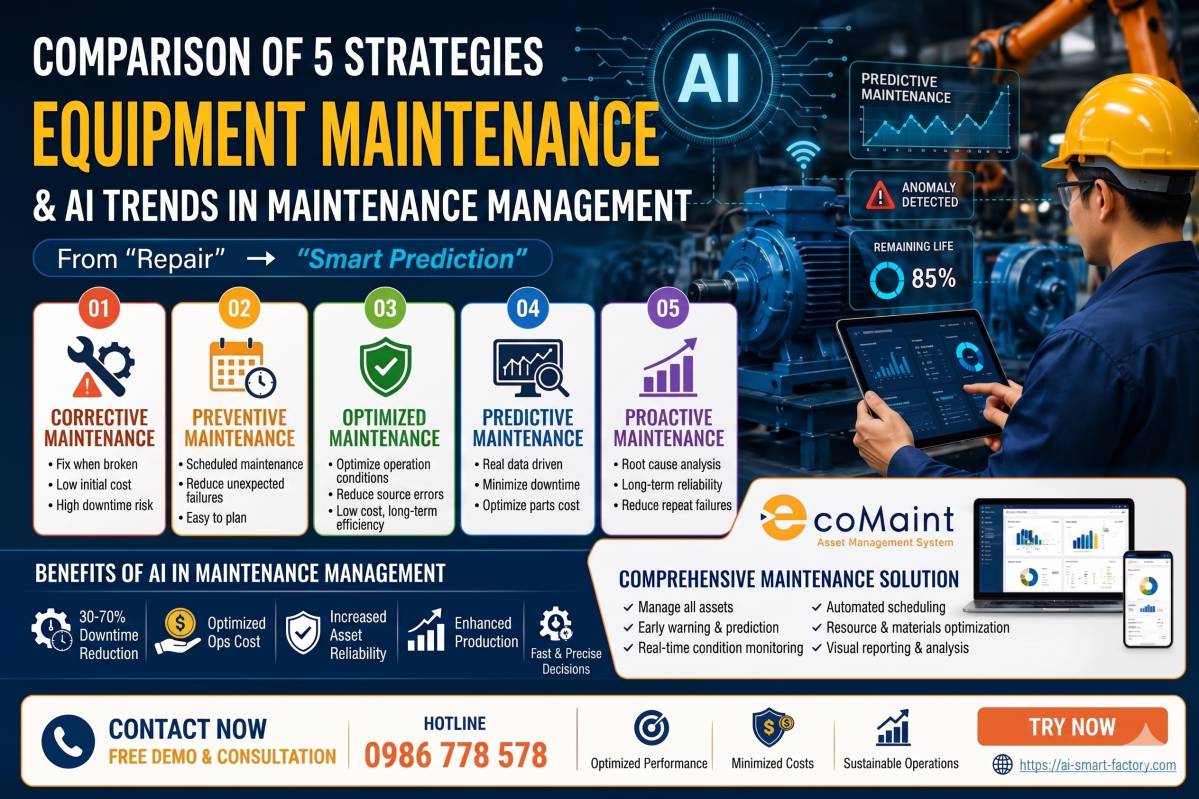
The image shows five maintenance methods widely applied in factories.
2.1 Reactive Maintenance
This is the simplest method: repair only when something breaks down.
Characteristics:
· No prior planning
· Intervention only after equipment has failed
Advantages:
· No initial investment cost
· Maximizes the service life of components
Disadvantages:
· Causes unexpected downtime
· High emergency repair costs
· Difficult to control operations
Suitable for:
· Auxiliary equipment
· Low-value machinery that is easy to replace
2.2 Preventive Maintenance
This method is based on a scheduled maintenance plan.
Examples:
Changing oil after every 3,000 operating hours
Inspecting equipment monthly
Advantages:
· Reduces unexpected failures
· Makes workforce planning easier
Disadvantages:
· May lead to “excessive” maintenance
· Can be costly if the schedule is not optimized
Suitable for:
· Standard equipment
· Machinery that wears out over time
2.3 Preactive Maintenance
This is an upgraded step from preventive maintenance, focusing on optimizing operating conditions from the beginning.
Examples:
· Ensuring lubrication meets required standards
· Keeping the operating environment clean and stable
Advantages:
· Reduces failures from the root
· Low cost with long-term effectiveness
Disadvantages:
Results may not be immediately visible
Suitable for:
· Continuous production lines
· Machinery requiring high operational stability
2.4 Predictive Maintenance
This is a modern method based on data and the actual condition of equipment.
How it works:
Uses sensors to measure vibration, temperature, and pressure
Analyzes data to predict failures
Advantages:
· Maintenance is performed only when necessary
· Minimizes downtime
· Optimizes spare parts and material costs
Disadvantages:
· High initial investment
· Requires a data system and technical expertise
Suitable for:
· Critical assets
· Production lines with high downtime costs
2.5 Proactive Maintenance
Unlike the methods above, this approach focuses on:
ð Identifying and eliminating the root causes of failures
Examples:
· Improving machine design
· Optimizing operating processes
Advantages:
· Increases long-term reliability
· Reduces recurring failures
Disadvantages:
· Requires a change in mindset and systems
· Requires in-depth analysis
Suitable for:
· Large-scale manufacturing enterprises
· Complex systems
Comparison Table of Equipment Maintenance Strategies
|
Criteria |
Reactive Maintenance |
Preventive Maintenance |
Preactive Maintenance |
Predictive Maintenance |
Proactive Maintenance |
|
Nature |
Passive |
Periodic |
Operational optimization |
Data-driven |
Strategic |
|
Investment cost |
Low |
Medium |
Low |
High |
Very high |
|
Long-term effectiveness |
Low |
Medium |
Good |
Very good |
Excellent |
|
Downtime |
High |
Medium |
Low |
Very low |
Lowest |
3. Trends in Equipment Maintenance Management: AI and Data-Driven Maintenance
In recent years, the application of AI in equipment maintenance has become an inevitable trend.
3.1 From Traditional Maintenance to Data-Driven Maintenance
In the past:
· Decisions were based on experience
· Businesses reacted after failures occurred
Today:
· Decisions are based on real-time data
· Risks are predicted in advance
=> This is called Data-driven Maintenance.
3.2 AI in Predictive Maintenance
AI helps elevate predictive maintenance to a new level.
AI capabilities include:
· Analyzing historical data
· Detecting anomalies
· Predicting equipment lifespan, also known as RUL — Remaining Useful Life
Benefits:
· Reduces downtime by 30–70%
· Optimizes maintenance schedules
· Reduces operating costs
3.3 AI Support for Troubleshooting
One of the most practical applications is:
=> AI helps technicians resolve faults faster.
Example:
The machine vibrates abnormally → The system suggests possible causes:
· Shaft misalignment
· Bearing wear
· Imbalance
Benefits:
· Shortens repair time
· Reduces dependence on experts
· Standardizes troubleshooting processes
3.4 AI Assistants in CMMS Systems
Today, many CMMS systems — Computerized Maintenance Management Systems — have integrated AI to:
· Look up repair history
· Suggest handling methods
· Quickly find technical documents
=> Technicians only need to “ask the system” instead of searching manually.
3.5 Automated Maintenance Planning
AI can:
· Recommend optimal maintenance schedules
· Allocate manpower
· Forecast spare parts and material demand
=> This helps businesses shift from:
Manual planning → to automated optimization.
4. Core Technologies for Smart Maintenance
To implement smart maintenance effectively, businesses often combine:
· IoT sensors for equipment monitoring
· CMMS/EAM systems
· Cloud and Big Data
· AI/Machine Learning
· Mobile apps for technicians
=> Together, these create a modern maintenance management ecosystem.
5. How Should Businesses Apply Maintenance Strategies?
There is no single method that fits all cases.
Recommended strategy:
· Critical equipment: Predictive Maintenance + AI
· Standard equipment: Preventive Maintenance
· Auxiliary equipment: Reactive Maintenance
· Entire system: Move toward Proactive Maintenance
6. Roadmap for Implementing Smart Maintenance in Enterprises
To achieve successful transformation, businesses should follow four stages:
Stage 1 — Digitization: Apply CMMS software to manage equipment lists and equipment history.
Stage 2 — Standardization: Build standardized preventive maintenance processes.
Stage 3 — Connectivity: Install IoT sensors to collect real-time data.
Stage 4 — Intelligence: Apply AI to analyze data and support automated decision-making.
Conclusion
The difference between a factory that operates smoothly and one that is constantly “putting out fires” does not lie in the quality of its equipment, but in its maintenance strategy.
Leading businesses do not wait for machines to break down before repairing them. They take control by:
· Predicting risks instead of reacting to failures
· Optimizing based on data instead of intuition
· Applying AI and IoT to automate processes\
The application of technology and AI is no longer optional. It has become a mandatory requirement for businesses to break through and lead in the era of smart manufacturing.
Are you looking for an optimal maintenance solution for your factory? Contact Vietsoft experts at 0986 778 578 for a consultation on an AI-integrated CMMS implementation roadmap today.